
Technical Support & Resources
Visit our FAQ
Contact Us
Toll Free Phone (USA and Canada Only): (888) 526-5351
Direct Phone: (734) 975-3888
Technical Information
- ADP-ribose Transferase 1
- ADPRT
- PARP1
- PARP-1
- NAD+ADP-ribosyltransferase 1
- Poly(ADP-ribose) Polymerase 1
- Poly(ADP-ribosyl)transferase
Shipping & Storage Information
Recommended Products
Certificates of Analysis & Batch Specific Data
Provide batch numbers separated by commas to download or request available product inserts, QC sheets, certificates of analysis, data packs, and GC-MS data.

Visit Our Cancer Resource Center
Find Tools & Resources to Study the Hallmarks of Cancer
- Cancer cell signaling & regulation
- Cancer metabolism
- Tumor microenvironment
Product Description
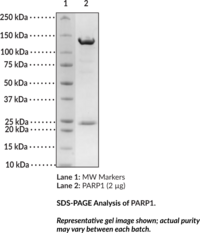
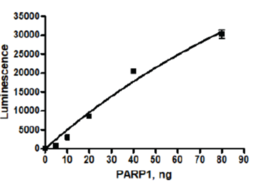
Poly(ADP-ribose) polymerase 1 (PARP1) is an ADP-ribosylating enzyme that has roles in DNA repair, maintenance of genomic integrity, and transcriptional regulation.1,2 It is composed of an N-terminal DNA-binding domain (DBD) that contains the nuclear localization signal (NLS) and three zinc fingers that mediate PARP1 self-assembly and activation, a central automodification domain, and a highly conserved C-terminal catalytic domain.1,3 PARP1 is ubiquitously expressed and localizes to the nucleus where it is recruited to sites of DNA damage induced by a variety of cellular stressors, including genomic, oxidative, inflammatory, or metabolic stress.4,1 Binding of PARP1 to DNA single- or double-strand breaks activates its poly(ADP)-ribosylation (PARylation) catalytic activity. PARP1 PARylates itself, increasing its activity and recruiting additional DNA repair proteins to sites of damaged DNA, as well as PARylates other proteins, including transcription factors, to facilitate DNA damage repair.4,1 PARP1 is subject to additional PTMs, including phosphorylation, methylation, and acetylation, that regulate its catalytic and DNA-binding activities.5 Increased PARP1 levels have been found in tumors isolated from patients with a variety of cancers, including soft tissue sarcoma and ovarian or squamous cell carcinomas, and are associated with decreased survival. Cayman's PARP1 (human, recombinant) protein can be used for enzyme assay applications. This protein consists of 1,040 amino acids and has a calculated molecular weight of 139 kDa.
WARNING This product is not for human or veterinary use.
References & Product Citations
1. The multifaceted roles of PARP1 in DNA repair and chromatin remodelling. Nat. Rev. Mol. Cell Biol. 18(10), 610-621 (2017).
2. Functional aspects of PARP1 in DNA repair and transcription. Biomolecules 2(4), 524-548 (2012).
3. Poly(ADP-
4. On PAR with PARP: Cellular stress signaling through poly(ADP-
5. Multifaceted role of PARP-
Contact Info
Cayman Chemical1180 East Ellsworth RoadAnn Arbor, Michigan 48108 USAToll Free: (800) 364-9897(USA and Canada only)Fax: (734) 971-3640


