
Technical Support & Resources
Visit our FAQ
Contact Us
Toll Free Phone (USA and Canada Only): (888) 526-5351
Direct Phone: (734) 975-3888
Product Categories
Technical Information
- Alox12
- Arachidonate 12-lipoxygenase
- 12-LO
- 12-LOX
Shipping & Storage Information
Recommended Products
Certificates of Analysis & Batch Specific Data
Provide batch numbers separated by commas to download or request available product inserts, QC sheets, certificates of analysis, data packs, and GC-MS data.
Lipid Resource Center
Discover Products & Resources for Lipid Research
- High-purity lipid standards
- Lipid roles in biology
- Lipids in health & disease
- Lipids for pharmaceutical development
- Protocols, advice, & resources
Product Description
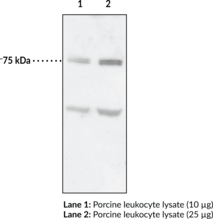
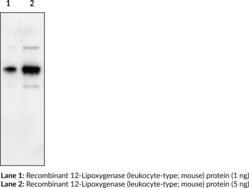
12-Lipoxygenase (12-LO) is one of several LOs that catalyzes the peroxidation of polyunsaturated fatty acids in a position-specific manner.1 There are four 12-LO subtypes, encoded by distinct genes, that can be categorized according to their tissue expression in mice.2 Leukocyte-type 12-LO is encoded by Alox15 in mice and shares 74% sequence identity with human ALOX15 but, in contrast to its human ortholog, encodes a 12-lipoxygenating ALOX15 isoform.3,4,5 Leukocyte-type 12-LO exists as a single polypeptide chain composed of an N-terminal regulatory domain and a C-terminal catalytic domain.1 It catalyzes the oxidation of arachidonic acid (Item Nos. 90010 | 90010.1 | 10006607) to 12(S)-HpETE (Item No. 44570) and, to a lesser extent, 15(S)-HpETE (Item No. 44720), which are further reduced to 12(S)-HETE (Item No. 34570) and 15(S)-HETE (Item No. 34720), respectively.1,6,7 Other substrates of leukocyte-type 12-LO include eicosapentaenoic acid, docosahexaenoic acid, linoleic acid, and γ-linolenic acid, which are oxygenated at various positions in a substrate-dependent manner.8 Leukocyte-type 12-LO is constitutively expressed at high levels in resident peritoneal macrophages, and its activity is increased by the Th2 cytokines IL-4 and IL-13 in vitro.5 Alox15-/- mice are protected from increases in systolic blood pressure in a model of hypertension induced by L-NAME (Item No. 80210).9 Cayman's 12-Lipoxygenase (mouse) Polyclonal Antibody can be used for ELISA and Western blot (WB) applications. The antibody recognizes 12-LO (leukocyte-type) at ~73 kDa from porcine and mouse samples.
WARNING This product is not for human or veterinary use.
References & Product Citations
1. Mammalian lipoxygenases and their biological relevance. Biochim. Biophys. Acta 1851(4), 308-330 (2015).
2. Inflammation and immune regulation by 12/15-
3. Structural and functional biology of arachidonic acid 15-
4. Evolutionary alteration of ALOX15 specificity optimizes the biosynthesis of antiinflammatory and proresolving lipoxins. Proc. Natl. Acad. Sci. USA 113(30), E4266–E4275 (2016).
5. Cytokine-
6. The role of lipoxygenases in pathophysiology; new insights and future perspectives. Redox Biol. 6, 297-310 (2015).
7. cDNA cloning, expression, mutagenesis of C-
8. Mammalian ALOX15 orthologs exhibit pronounced dual positional specificity with docosahexaenoic acid. Biochim. Biophys. Acta Mol. Cell Biol. Lipids 1862(7), 666-675 (2017).
9. Mice lacking macrophage 12/15-
Contact Info
Cayman Chemical1180 East Ellsworth RoadAnn Arbor, Michigan 48108 USAToll Free: (800) 364-9897(USA and Canada only)Fax: (734) 971-3640


