
Non-enzymatic oxidation product of EPA
Technical Support & Resources

Information provided in the product description is from published literature. Due to the nature of scientific experimentation, your results (e.g., selectivity and effective concentrations) or specific application for this product may differ. If you have questions about how this product fits your application, please contact our technical support staff.

Visit our FAQ

Contact Us

Toll Free Phone (USA and Canada Only): (888) 526-5351
Direct Phone: (734) 975-3888
Request Technical Support

Technical Support Request

To streamline the process attach the appropriate questionnaire to your inquiry.

Download IHC QuestionnaireDownload WB Questionnaire

View Our Privacy Statement for details on how we use and protect your data. In addition, this site is protected by hCaptcha and its Privacy Policy and Terms of Service apply.

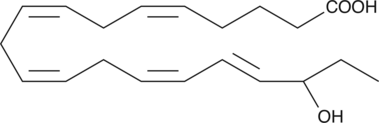
(±)18-HEPE

Item No. 32840

Technical Information
Formal Name
(±)-18-hydroxy-5Z,8Z,11Z,14Z,16E-eicosapentaenoic acid
CAS Number
141110-17-0
Molecular Formula
C20H30O3
Formula Weight
Purity
≥97%
A 100 µg/ml solution in ethanol
0.1 M Na2CO3: 2 mg/mlDMF: MiscibleDMSO: MiscibleEthanol: MisciblePBS (pH 7.2): 0.8 mg/ml
λmax
236 nm
SMILES
CCC(O)/C=C/C=C\C/C=C\C/C=C\C/C=C\CCCC(O)=O
InChi Code
InChI=1S/C20H30O3/c1-2-19(21)17-15-13-11-9-7-5-3-4-6-8-10-12-14-16-18-20(22)23/h4-7,10-13,15,17,19,21H,2-3,8-9,14,16,18H2,1H3,(H,22,23)/b6-4-,7-5-,12-10-,13-11-,17-15+
InChi Key
LRWYBGFSVUBWMO-UXNZXXPISA-N
Shipping & Storage Information
Storage
-20°C
Shipping
Wet ice in continental US; may vary elsewhere
Recommended Products

Certificates of Analysis & Batch Specific Data

Provide batch numbers separated by commas to download or request available product inserts, QC sheets, certificates of analysis, data packs, and GC-MS data.

    Add

    Add

    Add

    Add

    Lipid Resource Center
    Discover Products & Resources for Lipid Research
    • High-purity lipid standards
    • Lipid roles in biology
    • Lipids in health & disease
    • Lipids for pharmaceutical development
    • Protocols, advice, & resources
    EXPLORE NOW
    Product Description

    (±)18-HEPE is produced by non-enzymatic oxidation of eicosapentaenoic acid (EPA; Item Nos. 90110 | 90110.1 | 21908).1 18-HEPE levels are increased in the plasma and heart, as well as in the supernatant of cultured peritoneal macrophages isolated from fat-1 transgenic mice that are capable of endogenously producing ω-3 fatty acids from ω-6 fatty acids.2,3,4 It reduces increases in cardiac fibrosis and the expression of Nppa, Col1a1, Tgfb1, Cx3cl1, and Adgre1 induced by transverse aortic constriction in a mouse model of cardiac hypertrophy when administered at doses of 1 and 5 µg.3

    WARNING This product is not for human or veterinary use.

    References & Product Citations
    Product Description References

    1. Onodera, T., Fukuhara, A., Shin, J., et alEicosapentaenoic acid and 5-HEPE enhance macrophage-mediated Treg induction in mice. Sci. Rep. 7(1), 4560 (2017).

    2. Li, J., Chen, C.-Y., Arita, M., et alAn omega-3 polyunsaturated fatty acid derivative, 18-HEPE, protects against CXCR4-associated melanoma metastasis. Carcinogenesis 39(11), 1380-1388 (2018).

    3. Endo, J., Sano, M., Isobe, Y., et al18-HEPE, an n-3 fatty acid metabolite released by macrophages, prevents pressure overload-induced maladaptive cardiac remodeling. J. Exp. Med. 211(8), 1673-1687 (2014).

    4. Kang, J.X. Fat-1 transgenic mice: A new model for omega-3 research. Prostaglandins Leukot. Essent. Fatty Acids 77(5-6), 263-267 (2007).

    Product Citations

    Wu, Z., Xiao, H., Rao, D., et alAnalytical strategy for oxylipin annotation by combining chemical derivatization-based retention index algorithm and feature tandem mass spectrometric fragmentation as a biomarker discovery tool. Anal. Chem. 95(43), 15933-15942 (2023).

    Archambault, A.-S., Zaid, Y., Rakotoarivelo, V., et alHigh levels of eicosanoids and docosanoids in the lungs of intubated COVID-19 patients. The FASEB Journal 35(6), e21666 (2021).

    Roberts, L.M., Schwarz, B., Speranza, E., et alPulmonary infection induces persistent, pathogen-specific lipidomic changes influencing trained immunity. iScience 24(9), 103025 (2021).

    Brouwers, H., Jónasdóttir, H.S., Kuipers, M.E., et alAnti-inflammatory and proresolving effects of the omega-6 polyunsaturated fatty acid adrenic acid. J. Immunol. 205(10), 2840-2849 (2020).

    Meriwether, D., Sulaiman, D., Volpe, C., et alApolipoprotein A-I mimetics mitigate intestinal inflammation in COX2-dependent inflammatory bowel disease model. J. Clin. Invest. 130, 3670-3685 (2019).

    Dalli, J., Colas, R.A., Walker, M.E., et alLipid Mediator Metabolomics via LC-MS/MS Profiling and Analysis. Clinical Metabolomics 59-72 (2018).

