
Technical Support & Resources
Visit our FAQ
Contact Us
Toll Free Phone (USA and Canada Only): (888) 526-5351
Direct Phone: (734) 975-3888
Product Categories
Product Type
Technical Information
- C-C Motif Chemokine Ligand 5
- Regulated Upon Activation, Normally T Expressed and Secreted
- SIS-δ
- T Cell-specific Protein P288
- T Cell-specific Protein RANTES
- TCP288
Shipping & Storage Information
Recommended Products
Certificates of Analysis & Batch Specific Data
Provide batch numbers separated by commas to download or request available product inserts, QC sheets, certificates of analysis, data packs, and GC-MS data.

Visit Our Cancer Resource Center
Find Tools & Resources to Study the Hallmarks of Cancer
- Cancer cell signaling & regulation
- Cancer metabolism
- Tumor microenvironment
Product Description
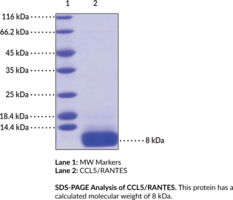
Chemokine (C-C motif) ligand 5 (CCL5), also known as RANTES, is a pro-inflammatory chemokine and member of the CC subfamily of chemokines.1 It is composed of an unstructured N-terminal region, a flexible loop, a 310-helix, three strands of an antiparallel β-sheet, and a single C-terminal α helix.2 It is expressed in T cells, platelets, macrophages, tubular epithelial cells, synovial fibroblasts, and endothelial cells, as well as some tumor cells.1 It functions as a monomer or various oligomers and interacts with the G protein-coupled receptors (GPCRs) chemokine (C-C motif) receptor 1 (CCR1), CCR3, CCR4, CCR5, and GPR75 to activate cell signaling in an oligomerization state-dependent manner. It also interacts with the non-signaling receptors ACKR1, ACKR2, and CCRL2. CCL5 functions as a chemoattractant of immune cells that predominantly express CCR5, such as activated T cells and monocytes, as well as those expressing CCR1 and CCR3, including macrophages and eosinophils, respectively.3 Production of CCL5 is induced in response to viral infections, including HIV, rhinoviruses, respiratory syncytial virus (RSV), coronaviruses, and influenza.4 CCL5 expression positively correlates with disease progression in patients with breast cancer.1 Cayman's CCL5/RANTES (human, recombinant) protein consists of 69 amino acids and has a calculated molecular weight of 8 kDa.
WARNING This product is not for human or veterinary use.
References & Product Citations
1. The potential to target CCL5/CCR5 in breast cancer. Expert Opin. Ther. Targets 18(11), 1265-1275 (2014).
2. The solution structure of monomeric CCL5 in complex with a doubly sulfated N-
3. CCL5: A double-
4. Targeting CCL5 in inflammation. Expert Opin. Ther. Targets 17(12), 1439-1460 (2013).
Contact Info
Cayman Chemical1180 East Ellsworth RoadAnn Arbor, Michigan 48108 USAToll Free: (800) 364-9897(USA and Canada only)Fax: (734) 971-3640


