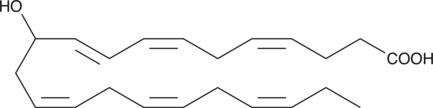
An autoxidation product of DHA and potential marker of oxidative stress
Technical Support & Resources

Information provided in the product description is from published literature. Due to the nature of scientific experimentation, your results (e.g., selectivity and effective concentrations) or specific application for this product may differ. If you have questions about how this product fits your application, please contact our technical support staff.

Visit our FAQ

Contact Us

Toll Free Phone (USA and Canada Only): (888) 526-5351
Direct Phone: (734) 975-3888

Request Technical Support

Technical Support Request

To streamline the process attach the appropriate questionnaire to your inquiry.

Download IHC QuestionnaireDownload WB Questionnaire

View Our Privacy Statement for details on how we use and protect your data. In addition, this site is protected by hCaptcha and its Privacy Policy and Terms of Service apply.

(±)11-HDHA

Item No. 33450

Technical Information
Formal Name
(±)11-hydroxy-4Z,7Z,9E,13Z,16Z,19Z-docosahexaenoic acid
CAS Number
87018-59-5
Synonyms
  • 11-hydroxy Docosahexaenoic Acid
  • (±)11-HDoHE
Molecular Formula
C22H32O3
Formula Weight
Purity
≥98%
A 100 µg/ml solution in ethanol
0.1 M Na2CO3: 2 mg/mlDMF: MiscibleDMSO: MiscibleEthanol: MisciblePBS (pH 7.2): 0.8 mg/ml
λmax
237 nm
SMILES
CC/C=C\C/C=C\C/C=C\CC(O)\C=C\C=C\C/C=C\CCC(=O)O
InChi Code
InChI=1S/C22H32O3/c1-2-3-4-5-6-7-9-12-15-18-21(23)19-16-13-10-8-11-14-17-20-22(24)25/h3-4,6-7,10-16,19,21,23H,2,5,8-9,17-18,20H2,1H3,(H,24,25)/b4-3-,7-6-,13-10-,14-11-,15-12-,19-16+
InChi Key
LTERDCBCHFKFRI-BGKMTWLOSA-N
Shipping & Storage Information
Storage
-20°C
Shipping
Wet ice in continental US; may vary elsewhere
Recommended Products

Certificates of Analysis & Batch Specific Data

Provide batch numbers separated by commas to download or request available product inserts, QC sheets, certificates of analysis, data packs, and GC-MS data.

    Add

    Add

    Add

    Add

    Lipid Resource Center
    Discover Products & Resources for Lipid Research
    • High-purity lipid standards
    • Lipid roles in biology
    • Lipids in health & disease
    • Lipids for pharmaceutical development
    • Protocols, advice, & resources
    EXPLORE NOW
    Product Description

    (±)11-HDHA is an autoxidation product of docosahexaenoic acid (DHA) in vitro.1,2 It is also produced from incubations of DHA in rat liver, brain, and intestinal microsomes.3,4,5 DHA is metabolized to 11(S)-HDHA by human platelets and canine retina.6,7,8,5 In addition to 11(S)-HDHA, 14(S)-HDHA is also produced by platelets.6,8,5 11(S)-HDHA was shown to be an inhibitor of U-46619-induced human platelet aggregation and rabbit and rat aortic smooth muscle contraction with IC50 values of about 50, 4.7, and 7.5 µM, respectively.8,9 (±)11-HDHA is a potential marker of oxidative stress in brain and retina where DHA is an abundant polyunsaturated fatty acid.

    WARNING This product is not for human or veterinary use.

    References & Product Citations
    Product Description References

    1. VanRollins, M., and Murphy, R.C. Autooxidation of docosahexaenoic acid: Analysis of ten isomers of hydroxydocosahexaenoate. J. Lipid Res. 25(5), 507-517 (1984).

    2. Reynaud, D., Thickitt, C.P., and Pace-Asciak, C.R. Facile preparation and structural determination of monohydroxy derivatives of docosahexaenoic acid (HDoHE) by α-tocopherol-directed autoxidation. Anal. Biochem. 214(1), 165-170 (1993).

    3. VanRollins, M., Baker, R.C., Sprecher, H., et alOxidation of docosahexaenoic acid by rat liver microsomes. The Journal of Biological Chemisty 259(9), 5776-5783 (1984).

    4. Yamane, M., Abe, A., and Yamane, S. High-performance liquid chromatography-thermospray mass spectrometry of epoxy polyunsaturated fatty acids and epoxyhydroxy polyunsaturated fatty acids from an incubation mixture of rat tissue homogenate. J. Chromatogr. 652(2), 123-136 (1994).

    5. Kim, H.Y., Karanian, J.W., Shingu, T., et alSterochemical analysis of hydroxylated docosahexaenoates produced by human platelets and rat brain homogenate. Prostaglandins 40(5), 473-490 (1990).

    6. Aveldaño, M.I., and Sprecher, H. Synthesis of hydroxy fatty acids from 4,7,10,13,16,19-[1-14C] docosahexaenoic acid by human platelets. The Journal of Biological Chemisty 258(15), 9339-9343 (1983).

    7. Bazan, N.G., Birkle, D.L., and Reddy, T.S. Docosahexaenoic acid (22:6, n-3) is metabolized to lipoxygenase reaction products in the retina. Biochem. Biophys. Res. Commun. 125(2), 741-747 (1984).

    8. Lagarde, M., Croset, M., Guichardant, M., et alRole of lipoxygenase products in platelet function: Relation to fatty acid modified phospholipids. Adv. Exp. Med. Biol. 192, 327-335 (1985).

    9. Karanian, J.W., Kim, H.Y., and Salem, N., Jr. Inhibitory effects of n-6 and n-3 hydroxy fatty acids on thromboxane (U46619)-induced smooth muscle contraction. J. Pharmacol. Exp. Ther. 270(3), 1105-1109 (1994).

    Product Citations

    Morgan, A.H., Hammond, V.J., Morgan, L., et alQuantitative assays for esterified oxylipins generated by immune cells. Nat. Protoc. 5(12), 1919-1931 (2010).