
Technical Support & Resources
Visit our FAQ
Contact Us
Toll Free Phone (USA and Canada Only): (888) 526-5351
Direct Phone: (734) 975-3888
Product Categories
Application

Technical Information
- CHX-d8
Shipping & Storage Information
Recommended Products
Certificates of Analysis & Batch Specific Data
Provide batch numbers separated by commas to download or request available product inserts, QC sheets, certificates of analysis, data packs, and GC-MS data.
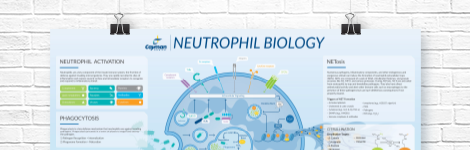
Neutrophil Biology Wall Poster
Explore how neutrophils shape the immune response in health and disease. This poster highlights neutrophil pathogen defense mechanisms, including phagocytosis, degranulation, and NETosis, as well as neutrophil roles in inflammation and NET-associated pathologies.
DOWNLOAD NOWProduct Description
Chlorhexidine-d8 is intended for use as an internal standard for the quantification of chlorhexidine (Item Nos. 17343 | 26924) by GC- or LC-MS. Chlorhexidine is a bis(biguanide) antimicrobial disinfectant and antiseptic agent.1 It inhibits growth of clinical methicillin-resistant S. aureus (MRSA) isolates (MIC90 = 4 μg/ml).2 It is also active against canine isolates of MRSA, methicillin-susceptible S. aureus (MSSA), methicillin-resistant S. pseudintermedius (MRSP), and methicillin-susceptible S. pseudintermedius (MSSP; MIC90s = 4, 2, 2, and 1 mg/L, respectively).3 Chlorhexidine inhibits growth of E. faecium strains (MICs = 1.2-19.6 μg/ml) and C. albicans (MIC = 5.15 μg/ml).4,5 It generates cations that bind to and destabilize the bacterial cell wall to induce death.6 Chlorhexidine also completely inhibits matrix metalloproteinase-2 (MMP-2) and MMP-9 when used at concentrations of 0.0001 and 0.002%, respectively, in a gelatin degradation assay.7 Formulations containing chlorhexidine have been used in antiseptic wound dressings, mouthwash, and toothpaste.
WARNING This product is not for human or veterinary use.
References & Product Citations
1. Chlorhexidine--
2. Chlorhexidine and mupirocin susceptibilities of methicillin-
3. Susceptibility in vitro of canine methicillin-
4. Reduced chlorhexidine and daptomycin susceptibility in vancomycin-
5. Stability and efficacy of combined nystatin and chlorhexidine against suspensions and biofilms of Candida albicans. Arch. Oral Biol. 89, 70-76 (2018).
6. The membrane destabilising action of the antibacterial agent chlorhexidine. FEMS Microbiol. Lett. 119(1-2), 249-253 (1994).
7. Inhibition of the activities of matrix metalloproteinases 2, 8, and 9 by chlorhexidine. Clin. Diag. Lab. Immun. 6(3), 437-439 (1999).
Contact Info
Cayman Chemical1180 East Ellsworth RoadAnn Arbor, Michigan 48108 USAToll Free: (800) 364-9897(USA and Canada only)Fax: (734) 971-3640


