
Technical Support & Resources
Visit our FAQ
Contact Us
Toll Free Phone (USA and Canada Only): (888) 526-5351
Direct Phone: (734) 975-3888
LL-37 Monoclonal Antibody (Clone 3G10)
Item No. 33679
Technical Information
- Antibacterial Protein LL-37
Shipping & Storage Information
Recommended Products
Certificates of Analysis & Batch Specific Data
Provide batch numbers separated by commas to download or request available product inserts, QC sheets, certificates of analysis, data packs, and GC-MS data.
NET Formation Screening & Analysis Services
Our experts are here to help.
- Detection of NET formation ex vivo and screening for modulators using:
- High-content imaging
- Enzymatic detection
- Citrullination/carbamylation detection
- Experienced scientists skilled in neutrophil biology, isolation, and handling
Product Description
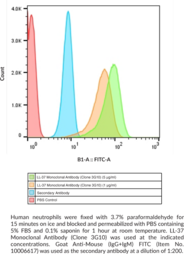
LL-37 is a cationic α-helical peptide expressed in human bone marrow, testis, granulocytes, gingival epithelium, and a variety of immune cells.1 It is produced by proteolytic cleavage of the cathelicidin human cationic antimicrobial protein of 18 kDa (hCAP18).2 LL-37 has antimicrobial and antiviral activity, and protein levels of LL-37 are increased in epithelial cells, macrophages, and neutrophils following bacterial infection in vitro.1,3,4,5 It functions as a chemoattractant for human monocytes, neutrophils, and T cells, and induces chemokine secretion from epithelial cells in infected tissues.6,2 LL-37 is a component of LPS-induced neutrophil extracellular traps (NETs) produced from human neutrophils isolated from patients with systemic lupus erythrematosus (SLE) or individuals without SLE.7 It also enhances formation of NETs induced by phorbol 12-myristate 13-acetate (PMA) or S. aureus.8 LL-37 can be citrullinated by protein arginine deiminase 2 (PAD2) and PAD4, a modification that reduces its antibacterial and antiviral activities.9,5 Native, but not citrullinated, LL-37 prevents mortality in a mouse model of D-galactosamine-sensitized endotoxic shock.9 Cayman's LL-37 Monoclonal Antibody (Clone 3G10) can be used for ELISA and flow cytometry (FC) applications.
WARNING This product is not for human or veterinary use.
References & Product Citations
1. Epithelial antimicrobial peptides: Review and significance for oral applications. Crit. Rev. Oral Biol. Med. 9(4), 399-414 (1998).
2. The human cathelicidin hCAP18/LL-
3. Expression of cathelicidin LL-
4. The human gene FALL39 and processing of the cathelin precursor to the antibacterial peptide LL-
5. Citrullination alters the antiviral and immunomodulatory activities of the human cathelicidin LL-
6. LL-
7. Neutrophil extracellular trap-
8. The antimicrobial peptide LL-
9. Citrullination alters immunomodulatory function of LL-
Contact Info
Cayman Chemical1180 East Ellsworth RoadAnn Arbor, Michigan 48108 USAToll Free: (800) 364-9897(USA and Canada only)Fax: (734) 971-3640


