
Technical Support & Resources
Visit our FAQ
Contact Us
Toll Free Phone (USA and Canada Only): (888) 526-5351
Direct Phone: (734) 975-3888
Product Categories
Application

Technical Information
- (±)-Ornidazole-d5
Shipping & Storage Information
Recommended Products
Certificates of Analysis & Batch Specific Data
Provide batch numbers separated by commas to download or request available product inserts, QC sheets, certificates of analysis, data packs, and GC-MS data.
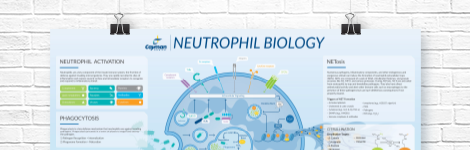
Neutrophil Biology Wall Poster
Explore how neutrophils shape the immune response in health and disease. This poster highlights neutrophil pathogen defense mechanisms, including phagocytosis, degranulation, and NETosis, as well as neutrophil roles in inflammation and NET-associated pathologies.
DOWNLOAD NOWProduct Description
Ornidazole-d5 is intended for use as an internal standard for the quantification of ornidazole (Item No. 26818) by GC- or LC-MS. Ornidazole is an orally bioavailable 5-nitroimidazole derivative with antibacterial and antiprotozoal activities.1,2 Ornidazole inhibits the growth of clinical isolates of B. fragilis (MICs = 0.5-5 μM) and various anaerobic bacteria when used at concentrations ranging from less than 0.1 to 3.2 μg/ml.2,3 It also inhibits the growth of Giardia isolates (IC50s = 0.01-0.47 μg/ml).4 Oral administration of ornidazole reduces T. vaginalis and T. foetus infection in mice and E. histolytica infection in rats with curative dose (CD50) values of 37, 3, and 10 mg/kg, respectively.1 Ornidazole (400 mg/kg per day) induces infertility in male rats within 7 days and inhibits spermatozoa binding to rat oocyte zona pellucida.5,6
WARNING This product is not for human or veterinary use.
References & Product Citations
1. Synthesis and antiprotozoal activity of 1-
2. Comparative evaluation of the 2-
3. Susceptibility of anaerobic bacteria to metronidazole, ornidazole, and tinidazole and routine susceptibility testing by standardized methods. Antimicrob. Agents Chemother. 11(4), 631-637 (1977).
4. Heterogeneity in the sensitivity of stocks and clones of Giardia to metronidazole and ornidazole. Trans. R. Soc. Trop. Med. Hyg. 85(1), 67-69 (1991).
5. Induction of reversible infertility in male rats by oral ornidazole and its effects on sperm motility and epididymal secretions. J. Reprod. Fertil. 100(2), 551-559 (1994).
6. Effect of ornidazole on fertility of male rats: Inhibition of a glycolysis-
Contact Info
Cayman Chemical1180 East Ellsworth RoadAnn Arbor, Michigan 48108 USAToll Free: (800) 364-9897(USA and Canada only)Fax: (734) 971-3640


