
Technical Support & Resources
Information provided in the product description is from published literature. Due to the nature of scientific experimentation, your results (e.g., selectivity and effective concentrations) or specific application for this product may differ. If you have questions about how this product fits your application, please contact our technical support staff.
Visit our FAQ
Contact Us
Toll Free Phone (USA and Canada Only): (888) 526-5351
Direct Phone: (734) 975-3888
Product Categories
Research Area

Technical Information
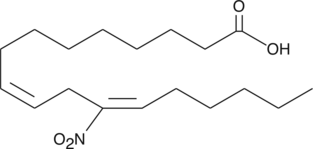
- 9(10)-Nitrooleic Acid
- OA-NO2
- 9(10)-nitro-9-trans-Octadecenoic Acid
Shipping & Storage Information
Recommended Products




Certificates of Analysis & Batch Specific Data
Provide batch numbers separated by commas to download or request available product inserts, QC sheets, certificates of analysis, data packs, and GC-MS data.
Lipid Resource Center
Discover Products & Resources for Lipid Research
- High-purity lipid standards
- Lipid roles in biology
- Lipids in health & disease
- Lipids for pharmaceutical development
- Protocols, advice, & resources
Product Description
9(10)-Nitrooleate is a mixture of the nitroalkene endogenous lipid signaling molecules 9-nitrooleate (Item No. 10008042) and 10-nitrooleate (Item No. 10008043). 9(10)-Nitrooleate is formed by nitration of oleic acid (Item Nos. 90260 | 24659) by peroxynitrite, acidified nitrite, and myeloperoxidase in the presence of hydrogen peroxide (H2O2) and nitrite.1 It induces transactivation of peroxisome proliferator-activated receptor γ (PPARγ) or nuclear factor erythroid 2-related factor 2 (Nrf2) in reporter assays using MCF-7 cells when used at concentrations greater than or equal to 0.3 and greater than or equal to 3 µM, respectively.2 9(10)-Nitrooleate also induces transactivation of PPARγ, PPARδ, or PPARα in reporter assays using CV-1 cells in a concentration-dependent manner.1 It induces adipogenesis in 3T3-L1 preadipocytes and glucose uptake in differentiated 3T3-L1 adipocytes when used at a concentration of 3 µM. In vivo, 9(10)-nitrooleate (500 µg/kg every six hours for 24 hours) decreases ischemia-induced increases in plasma levels of blood urea nitrogen, creatinine, and TNF-α and kidney levels of myeloperoxidase (Mpo) and IL-1β and reduces tubular necrosis and tubule dilation in a mouse model of renal ischemia-reperfusion injury.3
WARNING This product is not for human or veterinary use.
References & Product Citations
1. Fatty acid transduction of nitric oxide signaling. Multiple nitrated unsaturated acid derivatives exist in human blood and urine serve as endogenous peroxisome proliferator-
2. Nitroalkene fatty acids mediate activation of Nrf2/ARE-
3. Nitro-
Contact Info
Cayman Chemical1180 East Ellsworth RoadAnn Arbor, Michigan 48108 USAToll Free: (800) 364-9897(USA and Canada only)Fax: (734) 971-3640


