
Technical Support & Resources
Visit our FAQ
Contact Us
Toll Free Phone (USA and Canada Only): (888) 526-5351
Direct Phone: (734) 975-3888
Product Categories
Product Type
Technical Information
Shipping & Storage Information

Certificates of Analysis & Batch Specific Data
Provide batch numbers separated by commas to download or request available product inserts, QC sheets, certificates of analysis, data packs, and GC-MS data.

Visit Our Cancer Resource Center
Find Tools & Resources to Study the Hallmarks of Cancer
- Cancer cell signaling & regulation
- Cancer metabolism
- Tumor microenvironment
Product Description
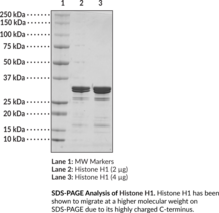
Histone H1 is a nuclear protein that interacts with linker DNA regions between nucleosomes to provide nucleosome core structure stabilization.1,2 Histone H1 subtypes are comprised of a short N-terminal domain, a central globular domain necessary for DNA interaction, and long C-terminal domain that determines subtype binding properties by its variability.2 Histones H1.1-H1.5 are expressed in somatic cells in a replication-dependent manner, and cell-type specificity varies based on histone H1 subtype.3 Histone H1 is involved in chromatin organization, gene expression, protection of DNA from digestion by micrococcal nuclease, the DNA damage response, and cell differentiation.2,4 Knockdown of H1-2 and H1-4 decreases proliferation of T47D breast cancer cells, and H1-2 knockdown also induces cell cycle arrest at the G1 phase in the same cells.5 Histone H1 is highly post-translationally modified, including phosphorylation, acetylation, citrullination, ubiquitination, and methylation.4 Phosphorylation of histone H1 at Thr146 is associated with increasing breast cancer tumor grade.6 Cayman’s Histone H1 (bovine) protein can be used as a substrate for enzyme activity assays, as well as for Western blot (WB) applications.
WARNING This product is not for human or veterinary use.
References & Product Citations
1. The structure of histone H1 and its location in chromatin. Nature 288(5792), 675-679 (1980).
2. Interplay between histone H1 structure and function. Biochim. Biophys. Acta 1859(3), 444-454 (2016).
3. Specificities and genomic distribution of somatic mammalian histone H1 subtypes. Biochim. Biophys. Acta 1859(3), 510-519 (2015).
4. Histone H1 post-
5. Depletion of human histone H1 variants uncovers specific roles in gene expression and cell growth. PLoS Genet. 4(10), e1000227 (2008).
6. Histone H1 phosphorylation in breast cancer. J. Proteome Res. 13(5), 2453-2467 (2014).
Contact Info
Cayman Chemical1180 East Ellsworth RoadAnn Arbor, Michigan 48108 USAToll Free: (800) 364-9897(USA and Canada only)Fax: (734) 971-3640


