
Technical Support & Resources
Visit our FAQ
Contact Us
Toll Free Phone (USA and Canada Only): (888) 526-5351
Direct Phone: (734) 975-3888
Product Categories
Product Type
Application
Technical Information
- Bcl-2-like Protein 3
- EAT/Mcl-1
- Induced Myeloid Leukemia Cell Differentiation Protein Mcl-1
- Mcl-1 Long Isoform
Shipping & Storage Information
Recommended Products
Certificates of Analysis & Batch Specific Data
Provide batch numbers separated by commas to download or request available product inserts, QC sheets, certificates of analysis, data packs, and GC-MS data.

Visit Our Cancer Resource Center
Find Tools & Resources to Study the Hallmarks of Cancer
- Cancer cell signaling & regulation
- Cancer metabolism
- Tumor microenvironment
Product Description
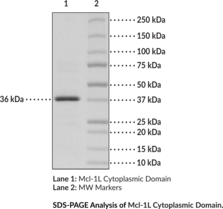
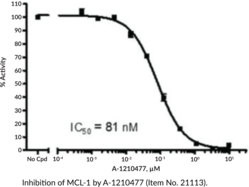
Myeloid cell leukemia-1 (Mcl-1) is a Bcl-2 family member protein that is involved in the regulation of apoptosis.1 Alternative splicing of MCL1 pre-mRNA produces three isoforms, anti-apoptotic Mcl-1 long (Mcl-1L) and pro-apoptotic Mcl-1 short and Mcl-1 extra short (Mcl-1S and Mcl-1ES, respectively). Mcl-1L is composed of a C-terminal helix that acts as a membrane anchor, four Bcl-2 homology (BH) domains, and a PEST domain. The BH1, BH2, and BH3 domains facilitate heterodimerization with pro-apoptotic proteins, including Bax and Bak, and homodimerization with Mcl-1S and Mcl-1ES.1,2,3 Mcl-1L is expressed during embryogenesis and hematopoiesis, as well as during nervous and immune system development, and localizes to the mitochondrial membrane.4,5 It inhibits apoptosis by preventing Bax and Bak oligomerization, which form a pore on the outer mitochondrial membrane that allows release of cytochrome c into the cytoplasm.1 Knockdown of MCL1 sensitizes oral cancer cells to cisplatin and tumor levels of Mcl-1L are increased relative to adjacent normal tissues in patients with oral cancer.6 Overexpression of MCL1 is associated with poor prognosis in several cancers, including solid tumors and hematological malignancies.1 Cayman’s Mcl-1L Cytoplasmic Domain (human, recombinant) protein can be used for enzyme activity assays.
WARNING This product is not for human or veterinary use.
References & Product Citations
1. Targeting MCL-
2. MCL-
3. MCL-
4. Anti-
5. The intracellular distribution and pattern of expression of Mcl-
6. Overexpression of Mcl-
Contact Info
Cayman Chemical1180 East Ellsworth RoadAnn Arbor, Michigan 48108 USAToll Free: (800) 364-9897(USA and Canada only)Fax: (734) 971-3640


