
Technical Support & Resources
Visit our FAQ
Contact Us
Toll Free Phone (USA and Canada Only): (888) 526-5351
Direct Phone: (734) 975-3888
Technical Information
- BCL2
Shipping & Storage Information
Recommended Products
Certificates of Analysis & Batch Specific Data
Provide batch numbers separated by commas to download or request available product inserts, QC sheets, certificates of analysis, data packs, and GC-MS data.

Visit Our Cancer Resource Center
Find Tools & Resources to Study the Hallmarks of Cancer
- Cancer cell signaling & regulation
- Cancer metabolism
- Tumor microenvironment
Product Description
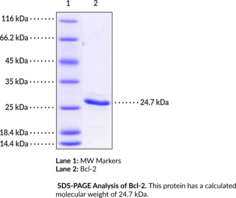
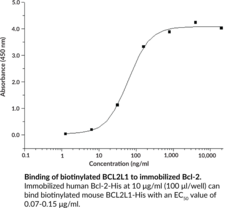
Bcl-2 is an anti-apoptotic protein and the founding member of the Bcl-2 family of proteins.1,2 Bcl-2 is composed of a C-terminal helix that acts as a membrane anchor and four highly conserved Bcl-2 homology (BH) domains.1 The BH1, BH2, and BH3 domains form a hydrophobic cleft that mediates protein-protein interactions with the pro-apoptotic proteins Bax and Bak, resulting in their inhibition, whereas the BH4 domain regulates intracellular calcium levels by interacting with the inositol-1,4,5-triphosphate receptor (IP3R) and ryanodine receptors (RyRs).3,1,4 Bcl-2 is highly expressed during embryogenesis and neuron and lymphocyte development and is primarily localized to the mitochondrial outer membrane.5 It inhibits the intrinsic apoptotic pathway by inhibiting Bax- or Bak-induced pore formation in the outer mitochondrial membrane, maintaining the mitochondrial membrane potential, and preventing the release of cytochrome c into the cytosol and the induction of apoptosis.2,3 Bcl-2 has oncogenic function, promoting tumor progression and angiogenesis, as well as metastasis.4 The Bcl2 t(14;18)(q32;q21) translocation results in Bcl-2 overexpression and is a hallmark of follicular lymphoma.6 Bcl-2 is also overexpressed in several other cancers, including chronic lymphocytic leukemia (CLL), diffuse large B cell lymphoma (DLBCL), and prostate cancer.3 Cayman's Bcl-2 (human, recombinant) protein can be used for binding assays. This protein consists of 221 amino acids and has a calculated molecular weight of 24.7 kDa.
WARNING This product is not for human or veterinary use.
References & Product Citations
1. Bcl-
2. The role of Bcl-
3. A dual role for the anti-
4. Non-
5. Anti-
6. Insights into the molecular pathogenesis of follicular lymphoma arising from analysis of geographic variation. Blood 99(12), 4265-4275 (2002).
Contact Info
Cayman Chemical1180 East Ellsworth RoadAnn Arbor, Michigan 48108 USAToll Free: (800) 364-9897(USA and Canada only)Fax: (734) 971-3640


