
Technical Support & Resources
Visit our FAQ
Contact Us
Toll Free Phone (USA and Canada Only): (888) 526-5351
Direct Phone: (734) 975-3888
Product Categories
Product Type
Application
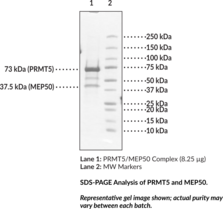
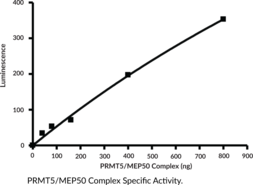
Technical Information
- Histone-arginine N-methyltransferase PRMT5
- IBP72
- Jak-binding Protein 1
- JBP1
- Protein-arginine N-methyltransferase 5
- Shk1 Kinase-binding protein 1 Homolog
- SKB1 Homolog
- 72 kDa ICIn-binding Protein
Shipping & Storage Information
Recommended Products
Certificates of Analysis & Batch Specific Data
Provide batch numbers separated by commas to download or request available product inserts, QC sheets, certificates of analysis, data packs, and GC-MS data.

Visit Our Cancer Resource Center
Find Tools & Resources to Study the Hallmarks of Cancer
- Cancer cell signaling & regulation
- Cancer metabolism
- Tumor microenvironment
Product Description
Protein-arginine N-methyltransferase 5 (PRMT5) is a type II PRMT and member of the class I S-adenosylmethionine-dependent methyltransferases that symmetrically dimethylates arginine residues in proteins and histones.1 It is composed of an N-terminal TIM domain and a C-terminal catalytic domain. PRMT5 proteins interact with methylosome 50 (MEP50) proteins primarily via the TIM domain to form a hetero-octameric complex that is more active than PRMT5 alone.2 Both PRMT5 and MEP50 are found in a wide variety of somatic and embryonic tissues, including the fetal ovary, fetal heart, and adult retina.3 The PRMT5-MEP50 complex methylates spliceosomal proteins and newly synthesized histone H2A in the cytoplasm and interacts with additional binding partners to regulate transcription through the methylation of NF-κB and p53 and other transcription factors in the nucleus. PRMT5 and MEP50 expression is increased in a variety of cancers and correlated with lower survival rates in patients with non-small cell lung cancer (NSCLC). Mutations in each gene are also associated with many types of cancer. Cayman's PRMT5-MEP50 protein can be used for enzyme activity assays.
WARNING This product is not for human or veterinary use.
References & Product Citations
1. The structure and function of the PRMT5:MEP50 complex. Macromolecular protein complexes 185-194 (2017).
2. Crystal structure of the human PRMT5:MEP50 complex. Proc. Natl. Acad. Sci. USA 109(44), 17960-17965 (2012).
3. The PRMT5 arginine methyltransferase: Many roles in development, cancer and beyond. Cell Mol. Life Sci. 72(11), 2041-2059 (2015).
Contact Info
Cayman Chemical1180 East Ellsworth RoadAnn Arbor, Michigan 48108 USAToll Free: (800) 364-9897(USA and Canada only)Fax: (734) 971-3640


