
Features
- Screen test samples to quantify functional activity, either agonist or antagonist, that they may exert against NFAT
- Robust technology provides sustained response for consistent and reproducible data acquisition
- Included in kit: Ready-to-use, NFAT reporter cells | Optimized media | The calcineurin-NFAT pathway activator Ionomycin| Luciferase Detection Reagent | Cell culture ready assay plate
Technical Support & Resources
Visit our FAQ
Contact Us
Toll Free Phone (USA and Canada Only): (888) 526-5351
Direct Phone: (734) 975-3888
Product Categories
Product Type
Application
Nuclear Factor of Activated T cells Reporter Assay System
Item No. 34038
Technical Information
- NFAT
Shipping & Storage Information
Recommended Products
Certificates of Analysis & Batch Specific Data
Provide batch numbers separated by commas to download or request available product inserts, QC sheets, certificates of analysis, data packs, and GC-MS data.


Visit Our Cancer Resource Center
Find Tools & Resources to Study the Hallmarks of Cancer
- Cancer cell signaling & regulation
- Cancer metabolism
- Tumor microenvironment
Product Description
The five members of the Nuclear Factor of Activated T cells (NFAT1-5) family were initially identified as key regulators of genes involved in the activation, proliferation, differentiation, and apoptosis of cells, most notably the T cells and B cells of the immune system. Inactive NFAT resides in the cytoplasm in a multi-phosphorylated form. Phospho-NFAT is converted to its active form through the action of calcineurin, a calcium-dependent phosphatase. Any physiological event that drives the influx of extra-cellular Ca+2, or depletes internal Ca+2 stores within the endoplasmic reticula, results in Ca2+-activation of calcineurin and its subsequent dephosphorylation of phospho-NFAT. Activated NFAT translocates to the nucleus where it binds to specific genetic response element (GREs) sequences within the promoter/enhancer region of target genes. Functional transcription complexes form via co-operative association with other transcription factors, most notably AP-12 . Importantly, dysregulation of the calcineurin-NFAT pathway is strongly associated with autoimmune diseases such as systemic lupus erythematosus and rheumatoid arthritis, thereby making it an important therapeutic target for small molecule drug development.
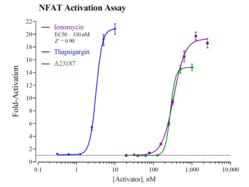
INDIGO's reporter cells contains an engineered luciferase reporter gene functionally linked to tandem NFAT/AP-1 GRE sequences positioned immediately upstream of a minimal promoter. Activated NFAT will bind to its corresponding GRE’s to initiate the formation of a complete transcription complex that drives Luc gene expression. Thus, quantifying changes in luciferase activity in the treated reporter cells provides a sensitive surrogate measure of changes in NFAT activity. Accordingly, the principal application of this reporter assay is in the screening of test compounds to quantify any functional activities, either activating or inhibitory, that they may exert against the calcineurin-NFAT signal transduction pathway.
Reporter cells are prepared using INDIGO’s proprietary CryoMite™ process. This cryopreservation method yields high cell viability post-thaw and provides the convenience of immediately dispensing healthy reporter cells into assay plates. There is no need for intermediate preparatory steps such as the spin-and-rinse of cells, viability determinations, cell titer adjustments, or the pre-incubation of reporter cells prior to assay setup. [INDIGO Catalog Nos. IB18001, IB18001-32, IB18002]
WARNING This product is not for human or veterinary use.
Contact Info
Cayman Chemical1180 East Ellsworth RoadAnn Arbor, Michigan 48108 USAToll Free: (800) 364-9897(USA and Canada only)Fax: (734) 971-3640


