
Technical Support & Resources
Information provided in the product description is from published literature. Due to the nature of scientific experimentation, your results (e.g., selectivity and effective concentrations) or specific application for this product may differ. If you have questions about how this product fits your application, please contact our technical support staff.
Visit our FAQ
Contact Us
Toll Free Phone (USA and Canada Only): (888) 526-5351
Direct Phone: (734) 975-3888
Product Categories
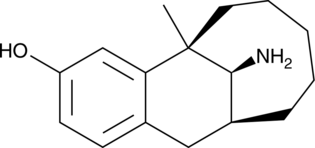
Technical Information
- Wy 16225
Shipping & Storage Information
Recommended Products
Certificates of Analysis & Batch Specific Data
Provide batch numbers separated by commas to download or request available product inserts, QC sheets, certificates of analysis, data packs, and GC-MS data.

Visit Our Cancer Resource Center
Find Tools & Resources to Study the Hallmarks of Cancer
- Cancer cell signaling & regulation
- Cancer metabolism
- Tumor microenvironment
Product Description
Dezocine is a partial agonist of the µ- and κ-opioid receptors.1 It is selective for µ- and κ-opioid receptors (Kis = 1.46 and 22.01 nM, respectively) over the δ-opioid receptor (Ki = 398.6 nM). Dezocine inhibits the norepinephrine transporter (NET) and serotonin transporter (SERT) with Ki values of 0.001 and 109 nM, respectively.2 It stimulates [35S]GTPγS binding to CHO membranes expressing the human µ- and κ-opioid receptors with Emax values of 45.8 and 33.6% compared to the µ- and κ-agonists DAMGO and U50,488 H, respectively, when used at a concentration of 10 µM.1 It has antinociceptive effects in mice in the acetic acid abdominal constriction test (ED50 = 0.02 mg/kg) and the formalin test (ED50s = 0.4 mg/kg for both phases).1 Dezocine (10 mg/kg) increases the latency to tail withdrawal in the tail-flick test in rats.3 It also decreases the number of lung metastases in a 4T1 murine mammary cancer model when administered at doses ranging from 0.75 to 2 mg/kg.4 Formulations containing dezocine have been used in the treatment of post-operative pain.
WARNING This product is not for human or veterinary use.
References & Product Citations
1. Pharmacological characterization of dezocine, a potent analgesic acting as a κ partial agonist and μ partial agonist. Sci. Rep. 8(1), 14087 (2018).
2. Novel molecular targets of dezocine and their clinical implications. Anesthesiology 120(3), 714-723 (2014).
3. An examination of the interactions between the antinociceptive effects of morphine and various mu-
4. Dezocine promotes T lymphocyte activation and inhibits tumor metastasis after surgery in a mouse model. Invest New Drugs 38(5), 1342-1349 (2020).
Contact Info
Cayman Chemical1180 East Ellsworth RoadAnn Arbor, Michigan 48108 USAToll Free: (800) 364-9897(USA and Canada only)Fax: (734) 971-3640


