
Technical Support & Resources
Information provided in the product description is from published literature. Due to the nature of scientific experimentation, your results (e.g., selectivity and effective concentrations) or specific application for this product may differ. If you have questions about how this product fits your application, please contact our technical support staff.
Visit our FAQ
Contact Us
Toll Free Phone (USA and Canada Only): (888) 526-5351
Direct Phone: (734) 975-3888
Product Categories

Technical Information
Shipping & Storage Information
Recommended Products
Certificates of Analysis & Batch Specific Data
Provide batch numbers separated by commas to download or request available product inserts, QC sheets, certificates of analysis, data packs, and GC-MS data.
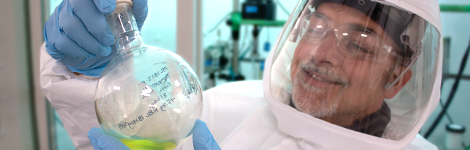
Ionizable Lipids – Your Path from R&D to GMP
Seamlessly bridge your LNP discovery journey from RUO to bulk GLP-tox and GMP excipient-grade material.
Explore CGMP Lipid ServicesProduct Description
ALC-0315 is an ionizable cationic lipid (pKa 6.09) that has been used in the generation of lipid nanoparticles (LNPs) for the delivery of mRNA, siRNA, and plasmid DNA in vitro and in vivo.1,2,3,4 LNPs containing ALC-0315 and encapsulating siRNA targeting Factor VII mRNA decrease Factor VII mRNA levels in hepatocytes in mice.3 Administration of severe acute respiratory coronavirus 2 (SARS-CoV-2) mRNA in ALC-0315-containing LNPs induces the production of IgG that binds to the SARS-CoV-2 receptor-binding domain (RBD) in rhesus macaques, with a boost in antigen-specific IgG geometric mean titers (GMT) seven and 14 days after a second dose. LNPs containing ALC-0315 and encapsulating ovalbumin mRNA reduce tumor volume in an ovalbumin-expressing B16/F10 murine melanoma model.5 Formulations containing ALC-0315 have been used in the development of LNPs for the delivery of mRNA-based vaccines.
WARNING This product is not for human or veterinary use.
References & Product Citations
1. Lipids and lipid nanoparticle formulations for delivery of nucleic acids. US 10,166,298 B2, (2019).
2. BNT162b vaccines protect rhesus macaques from SARS-
3. Comparison of DLin-
4. The expression kinetics and immunogenicity of lipid nanoparticles delivering plasmid DNA and mRNA in mice. Vaccines (Basel) 11(10), 1580 (2023).
5. Lipid nanoparticle-
Ionizable lipid-
High-
Controlling reactogenicity while preserving immunogenicity from a self-
Mechanism of action of 1-
Optimization of polyethylene glycol shielding and mannose density on the lipid nanoparticles for efficient delivery to macrophages and spleens. Int. J. Pharm. 662, 124540 (2024).
Contact Info
Cayman Chemical1180 East Ellsworth RoadAnn Arbor, Michigan 48108 USAToll Free: (800) 364-9897(USA and Canada only)Fax: (734) 971-3640


