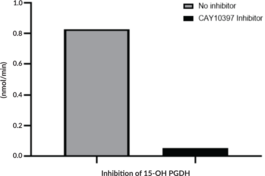
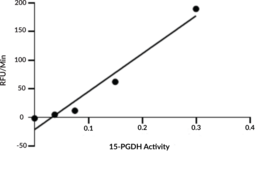
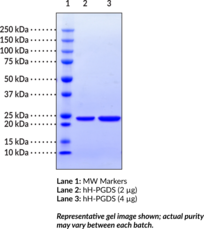
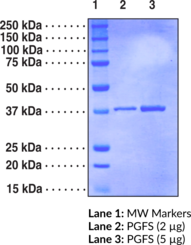
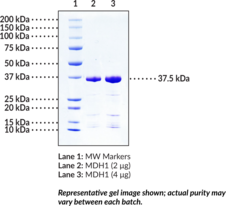
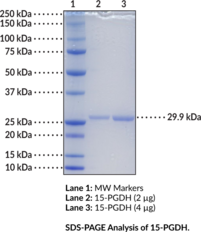
Active • Host: E. coli • AA: 3-256 • Tag: C-terminal His • MW: 29.9 kDa
Technical Support & Resources

Visit our FAQ

Contact Us

Toll Free Phone (USA and Canada Only): (888) 526-5351
Direct Phone: (734) 975-3888
Request Technical Support

Technical Support Request

To streamline the process attach the appropriate questionnaire to your inquiry.

Download IHC QuestionnaireDownload WB Questionnaire

View Our Privacy Statement for details on how we use and protect your data. In addition, this site is protected by hCaptcha and its Privacy Policy and Terms of Service apply.

15-hydroxy Prostaglandin Dehydrogenase D50H variant (human, recombinant)

Item No. 34486

Technical Information
Synonyms
  • NAD+-dependent 15-hydroxy Prostaglandin Dehydrogenase
  • Prostaglandin Dehydrogenase 1
  • Short-chain Dehydrogenase/Reductase Family 36C Member 1
Purity
≥90% estimated by SDS-PAGE
Source
Active recombinant human C-terminal His-tagged 15-PGDH expressed in E. coli
Amino Acids
3-256
MW
29.9 kDa
50 mM potassium phosphate, pH 7.6, with 150 mM sodium chloride, 1 mM EDTA, 0.1 mM DTT, and 5% glycerol
UniProt Accession №
P15428
Shipping & Storage Information
Storage
-80°C
Shipping
Dry ice in continental US; may vary elsewhere
Recommended Products

Certificates of Analysis & Batch Specific Data

Provide batch numbers separated by commas to download or request available product inserts, QC sheets, certificates of analysis, data packs, and GC-MS data.

    Add

    Lipid Resource Center
    Discover Products & Resources for Lipid Research
    • High-purity lipid standards
    • Lipid roles in biology
    • Lipids in health & disease
    • Lipids for pharmaceutical development
    • Protocols, advice, & resources
    EXPLORE NOW
    Product Description

    15-hydroxy Prostaglandin dehydrogenase (PGDH) is an enzyme of the short-chain alcohol dehydrogenase family that catalyzes the oxidation of prostaglandins to 15-keto metabolites with reduced biological activity.1,2,3,4 It uses NAD+ as a cofactor and, in addition to PGs, also converts various hydroxy fatty acids, such as HETEs, resolvins, and lipoxins, to less active keto metabolites.4,5,6,7,8 15-PGDH acts as a tumor suppressor, and restoring HPGD, the gene encoding 15-PGDH, expression in human colon cancer cells in vitro reduces subsequent tumor formation in mouse xenograft models.9,10,11,12 Knockout of Hpgd or inhibition of 15-PGDH in mice increases hepatic tissue regeneration and induces resistance to ulcerative colitis.13 Inhibition of 15-PGDH also increases mitochondrial function and autophagic flux in muscle tissue, as well as increases muscle mass and strength in aged mice.14 Cayman’s 15-PGDH D50H variant (human, recombinant) protein contains an aspartate-to-histidine substitution at position 50 (D50H) and can be used for enzyme assay and Western blot (WB) applications.

    WARNING This product is not for human or veterinary use.

    References & Product Citations
    Product Description References

    1. Jörnvall, H., Persson, B., Krook, M., et alShort-chain dehydrogenases/reductases (SDR). Biochem. 34(18), 6003-6013 (1995).

    2. Krook, M., Marekov, L., and Jörnvall, H. Purification and structural characterization of placental NAD+-linked 15-hydroxyprostaglandin dehydrogenase. The primary structure reveals the enzyme to belong to the short-chain alcohol dehydrogenase family. Biochemistry 29(3), 738-743 (1990).

    3. Hansen, H.S. 15-Hydroxyprostaglandin dehydrogenase. A review. Prostaglandins 12(4), 647-679 (1976).

    4. Ensor, C.M., and Tai, H.-H. 15-Hydroxyprostaglandin dehydrogenase. J. Lipid Mediat. Cell Signal. 12(2-3), 313-319 (1995).

    5. Maddox, J.F., Colgan, S.P., Clish, C.B., et alLipoxin B4 regulates human monocyte/neutrophil adherence and motility: Design of stable lipoxin B4 analogs with increased biologic activity. The FASEB Journal 12(6), 487-494 (1998).

    6. Sun, Y.P., Oh, S.F., Uddin, J., et alResolvin D1 and its aspirin-triggered 17R epimer stereochemical assignments, anti-inflammatory properties, and enzymatic inactivation. The Journal of Biological Chemisty 282(13), 9323-9334 (2007).

    7. Di Marzo, V. Endocannabinoids: Synthesis and degradation. Rev. Physiol. Biochem. Pharmacol. 160, 1-24 (2006).

    8. Hoffmann, F.M., and Maser, E. Carbonyl reductases and pluripotent hydroxysteroid dehydrogenases of the short-chain dehydrogenase/reductase superfamily. Drug Metab. Rev. 39(1), 87-144 (2007).

    9. Wolf, I., O'Kelly, J., Rubinek, T., et al15-Hydroxyprostaglandin dehydrogenase is a tumor suppressor of human breast cancer. Cancer Res. 66(15), 7818-7823 (2006).

    10. Myung, S.J., Rerko, R.M., Yan, M., et al15-Hydroxyprostaglandin dehydrogenase is an in vivo suppressor of colon tumorigenesis. Proc. Natl. Acad. Sci. USA 103(32), 12098-12102 (2006).

    11. Yan, M., Rerko, R.M., Platzer, P., et al15-Hydroxyprostaglandin dehydrogenase, a COX-2 oncogene antagonist, is a TGF-β-induced suppressor of human gastrointestinal cancers. Proc. Natl. Acad. Sci. USA 101(50), 17468-17473 (2004).

    12. Pham, H., Chen, M., Li, A., et alLoss of 15-hydroxyprostaglandin dehydrogenase increases prostaglandin E2 in pancreatic tumors. Pancreas 39(3), 332-339 (2010).

    13. Zhang, Y., Desai, A., Yang, S.Y., et alInhibition of the prostaglandin-degrading enzyme 15-PGDH potentiates tissue regeneration. Science 348(6240), aaa2340 (2015).

    14. Palla, A.R., Ravichandran, M., Wang, Y.X., et alInhibition of prostaglandin-degrading enzyme 15-PGDH rejuvenates aged muscle mass and strength. Science 371(6528), eabc8059 (2021).