
Technical Support & Resources
Visit our FAQ
Contact Us
Toll Free Phone (USA and Canada Only): (888) 526-5351
Direct Phone: (734) 975-3888
Technical Information
- Motch A
- Neurogenic Locus Notch Homolog Protein 1
- Notch Receptor 1
- Tan1
Shipping & Storage Information
Recommended Products
Certificates of Analysis & Batch Specific Data
Provide batch numbers separated by commas to download or request available product inserts, QC sheets, certificates of analysis, data packs, and GC-MS data.

Visit Our Cancer Resource Center
Find Tools & Resources to Study the Hallmarks of Cancer
- Cancer cell signaling & regulation
- Cancer metabolism
- Tumor microenvironment
Product Description
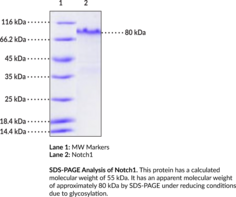
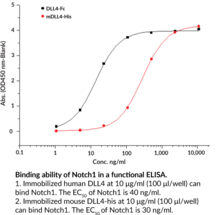
Notch1 is a single-pass transmembrane receptor and member of the Notch family.1 It is synthesized as a precursor that is cleaved by a furin-like convertase to produce two subunits: the noncovalently associated extracellular (NEC) subunit, which contains 36 EGF-like repeats involved in ligand binding, and the transmembrane (NTM) subunit, which contains the transmembrane domain and several other domains that, together, act as a ligand-activated transcription factor.1,2,3 Notch1 is expressed in endothelial cells, primarily in arteries, as well as in epididymal and subcutaneous fat and the brain.4,5 It is bound by ligands from the Jagged or Delta families expressed on adjacent cells, which induces a conformational change and sequential cleavage by a disintegrin and metalloproteinase domain-containing protein (ADAM) and γ-secretase, releasing the intracellular domain, which translocates to the nucleus and induces the transcription of Notch1 target genes as part of a transcriptional activation complex.3 Notch1 is necessary for arterial-venous differentiation during development and the maintenance of hippocampal stem cells in adulthood.4,6 It is also involved in tumorigenesis, regulating cell adhesion and metastasis, and is associated with a variety of solid tumor and hematological cancers.7,8 Mutations in NOTCH1 have been found in patients with chronic lymphocytic leukemia (CLL) and T cell acute lymphoblastic leukemia (T-ALL) and are associated with poor outcomes in patients with CLL.3 Cayman’s Notch1 (mouse, recombinant; aa 19-526) protein can be used for binding assays. This protein consists of 518 amino acids, has a calculated molecular weight of 55 kDa, and a predicted N-terminus of Ala-19 after signal peptide cleavage. By SDS-PAGE, under reducing conditions, the apparent molecular mass of the protein is 80 kDa due to glycosylation.
WARNING This product is not for human or veterinary use.
References & Product Citations
1. Nuclear magnetic resonance structure of a prototype Lin12-
2. NOTCH1 extracellular juxtamembrane expansion mutations in T-
3. NOTCH1 aberrations in chronic lymphocytic leukemia. Front Oncol. 8, 229 (2018).
4. Notch signaling in vascular development. Arterioscler. Thromb. Vasc. Biol. 23(4), 543-553 (2003).
5. Notch1 deficiency decreases hepatic lipid accumulation by induction of fatty acid oxidation. Sci Rep. 6, 19377 (2016).
6. Notch1 is required for maintenance of the reservoir of adult hippocampal stem cells. J. Neurosci. 30(31), 10484-10492 (2010).
7. Notch1 controls cell invasion and metastasis in small cell lung carcinoma cell lines. Lung Cancer 86(3), 304-310 (2014).
8. Notch1 in cancer therapy: Possible clinical implications and challenges. Mol. Pharmacol. 98(5), 559-576 (2020).
Contact Info
Cayman Chemical1180 East Ellsworth RoadAnn Arbor, Michigan 48108 USAToll Free: (800) 364-9897(USA and Canada only)Fax: (734) 971-3640


