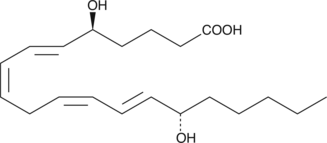
A dihydroxy fatty acid synthesized by 15-LO from 5(S)-HETE
Technical Support & Resources

Information provided in the product description is from published literature. Due to the nature of scientific experimentation, your results (e.g., selectivity and effective concentrations) or specific application for this product may differ. If you have questions about how this product fits your application, please contact our technical support staff.

Visit our FAQ

Contact Us

Toll Free Phone (USA and Canada Only): (888) 526-5351
Direct Phone: (734) 975-3888

Request Technical Support

Technical Support Request

To streamline the process attach the appropriate questionnaire to your inquiry.

Download IHC QuestionnaireDownload WB Questionnaire

View Our Privacy Statement for details on how we use and protect your data. In addition, this site is protected by hCaptcha and its Privacy Policy and Terms of Service apply.

5(S),15(S)-DiHETE

Item No. 35280

Technical Information
Formal Name
5S,15S-dihydroxy-6E,8Z,10Z,13E-eicosatetraenoic acid
CAS Number
82200-87-1
Molecular Formula
C20H32O4
Formula Weight
Purity
≥95%
A 100 µg/ml solution in ethanol
DMF: 50 mg/mlDMSO: 50 mg/mlEthanol: 50 mg/mlPBS (pH 7.2): 1 mg/ml
λmax
243 nm
SMILES
CCCCC[C@H](O)/C=C/C=C\C/C=C\C=C\[C@@H](O)CCCC(O)=O
InChi Code
InChI=1S/C20H32O4/c1-2-3-9-13-18(21)14-10-7-5-4-6-8-11-15-19(22)16-12-17-20(23)24/h5-8,10-11,14-15,18-19,21-22H,2-4,9,12-13,16-17H2,1H3,(H,23,24)/b7-5-,8-6-,14-10+,15-11+/t18-,19+/m0/s1
InChi Key
UXGXCGPWGSUMNI-BVHTXILBSA-N
Shipping & Storage Information
Storage
-20°C
Shipping
Wet ice in continental US; may vary elsewhere
Recommended Products

Certificates of Analysis & Batch Specific Data

Provide batch numbers separated by commas to download or request available product inserts, QC sheets, certificates of analysis, data packs, and GC-MS data.

    Add

    Add

    Add

    Lipid Resource Center
    Discover Products & Resources for Lipid Research
    • High-purity lipid standards
    • Lipid roles in biology
    • Lipids in health & disease
    • Lipids for pharmaceutical development
    • Protocols, advice, & resources
    EXPLORE NOW
    Product Description

    5(S),15(S)-DiHETE is synthesized by 15-LO from 5(S)-HETE.1 It potentiates the degranulation of human PMNL in response to PAF, but not fMLP, calcium ionophore A23187, or LTB4.2 5(S),15(S)-DiHETE is chemotactic for eosinophils with an ED50 value of 0.3 µM.3

    WARNING This product is not for human or veterinary use.

    References & Product Citations
    Product Description References

    1. Green, F.A. Transformations of 5-HETE by activated keratinocyte 15-lipoxygenase and the activation mechanism. Lipids 25, 618-623 (1990).

    2. O'Flaherty, J.T., and Thomas, M.J. Effect of 15-lipoxygenase-deprived arachidonate metabolites on human neutrophil degranulation. Prostaglandins Leukot. Med. 17, 199-212 (1985).

    3. Morita, E., Schröder, J.M., and Christophers, E. Identification of a novel and highly potent eosinophil chemotactic lipid in human eosinophils treated with arachidonic acid. J. Immunol. 144, 1893-1900 (1990).

    Product Citations

    Wu, Z., Xiao, H., Rao, D., et alAnalytical strategy for oxylipin annotation by combining chemical derivatization-based retention index algorithm and feature tandem mass spectrometric fragmentation as a biomarker discovery tool. Anal. Chem. 95(43), 15933-15942 (2023).

    Archambault, A.-S., Zaid, Y., Rakotoarivelo, V., et alHigh levels of eicosanoids and docosanoids in the lungs of intubated COVID-19 patients. FASEB J. 35(6), e21666 (2021).

    Roberts, L.M., Schwarz, B., Speranza, E., et alPulmonary infection induces persistent, pathogen-specific lipidomic changes influencing trained immunity. iScience 24(9), 103025 (2021).

    Hartling, I., Cremonesi, A., Osuna, E., et alQuantitative profiling of inflammatory and pro-resolving lipid mediators in human adolescents and mouse plasma using UHPLC-MS/MS. Clin. Chem. Lab. Med. 59(11), 1811-1823 (2021).

    Archambault, A.-S., Zaid, Y., Rakotoarivelo, V., et alLipid storm within the lungs of severe COVID-19 patients: Extensive levels of cyclooxygenase and lipoxygenase-derived inflammatory metabolites. medRxiv (2020).