
Technical Support & Resources
Information provided in the product description is from published literature. Due to the nature of scientific experimentation, your results (e.g., selectivity and effective concentrations) or specific application for this product may differ. If you have questions about how this product fits your application, please contact our technical support staff.
Visit our FAQ
Contact Us
Toll Free Phone (USA and Canada Only): (888) 526-5351
Direct Phone: (734) 975-3888
Product Categories
Technical Information
Shipping & Storage Information
Recommended Products
Certificates of Analysis & Batch Specific Data
Provide batch numbers separated by commas to download or request available product inserts, QC sheets, certificates of analysis, data packs, and GC-MS data.
Lipid Resource Center
Discover Products & Resources for Lipid Research
- High-purity lipid standards
- Lipid roles in biology
- Lipids in health & disease
- Lipids for pharmaceutical development
- Protocols, advice, & resources
Product Description
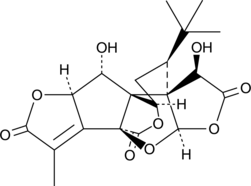
Ginkgolide K is a terpene trilactone that has been found in G. biloba and has diverse biological activities.1,2,3 It reduces corpus callosum demyelination, increases the distance traveled in the elevated plus maze, and reduces immobility time in the forced swim test in mice in a model of cuprizone-induced demyelination when administered at a dose of 20 mg/kg per day.2 Ginkgolide K (4 and 8 mg/kg) reduces infarct volume, improves neurological deficits, reverses decreases in superoxide dismutase (SOD) activity, and reverses increases in the levels of malondialdehyde (MDA) and nitric oxide (NO) in cerebral ischemic sections and serum in a rat model of cerebral ischemia-reperfusion injury induced by middle cerebral artery occlusion (MCAO).3
WARNING This product is not for human or veterinary use.
References & Product Citations
1. Ginkgolides and bilobalide: Their physical, chromatographic and spectroscopic properties. Bioorg. Med. Chem. 13(17), 5001-5012 (2005).
2. Ginkgolide K supports remyelination via induction of astrocytic IGF/PI3K/Nrf2 axis. Int. Immunopharmacol. 75, 105819 (2019).
3. Neuroprotective effect of ginkgolide K against acute ischemic stroke on middle cerebral ischemia occlusion in rats. J. Nat. Med. 66(1), 25-31 (2012).
Contact Info
Cayman Chemical1180 East Ellsworth RoadAnn Arbor, Michigan 48108 USAToll Free: (800) 364-9897(USA and Canada only)Fax: (734) 971-3640


