
Technical Support & Resources
Visit our FAQ
Contact Us
Toll Free Phone (USA and Canada Only): (888) 526-5351
Direct Phone: (734) 975-3888
Product Categories
Technical Information
- Nuclear Factor-κB (p105/p50)
Shipping & Storage Information
Recommended Products
Certificates of Analysis & Batch Specific Data
Provide batch numbers separated by commas to download or request available product inserts, QC sheets, certificates of analysis, data packs, and GC-MS data.

Visit Our Cancer Resource Center
Find Tools & Resources to Study the Hallmarks of Cancer
- Cancer cell signaling & regulation
- Cancer metabolism
- Tumor microenvironment
Product Description
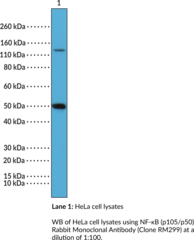
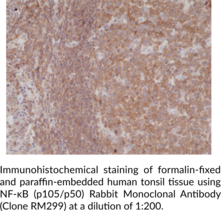
NF-κB is a ubiquitously expressed transcription factor composed of varied combinations of five subunits: p65/RelA, RelB, c-Rel, p105/p50, and p100/p52.1,2,3 The NF-κB p50 subunit is a truncated version of p105 that lacks ankyrin repeat domains.2 The p105 subunit can be phosphorylated by GSK3β, which prevents p105 processing and degradation in resting cells.3 In TNF-α-stimulated cells, GSK3β phosphorylation induces processing of p105 into p50, which forms a heterodimer with p65 and is translocated to the nucleus to initiate the transcription of a variety of genes involved in innate and adaptive immunity. The p105 subunit can also be phosphorylated by the IKKβ complex downstream of TNF receptor 1 (TNFR1), inducing processing of p105 into p50, or by tumor progression locus 2 (TPL2) downstream of toll-like receptor 4 (TLR4) activation by LPS. Increased protein levels of NF-κB, irrespective of cytoplasmic or nuclear localization, are associated with lower overall survival and disease-free survival in patients with solid tumors.4 Cayman’s NF-κB (p105/p50) Rabbit Monoclonal Antibody (Clone RM299) can be used for immunohistochemistry (IHC) and Western blot (WB) applications.
WARNING This product is not for human or veterinary use.
References & Product Citations
1. NF-
2. Shaping the nuclear action of NF-
3. Phosphorylation of NF-
4. NF-
Contact Info
Cayman Chemical1180 East Ellsworth RoadAnn Arbor, Michigan 48108 USAToll Free: (800) 364-9897(USA and Canada only)Fax: (734) 971-3640


