
Technical Support & Resources
Visit our FAQ
Contact Us
Toll Free Phone (USA and Canada Only): (888) 526-5351
Direct Phone: (734) 975-3888
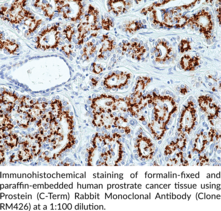
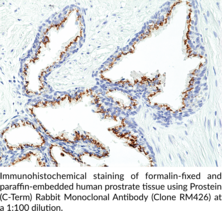
Technical Information
- p501s
- PCANAP6
- Prostate Cancer-associated Protein 6
Shipping & Storage Information
Recommended Products
Certificates of Analysis & Batch Specific Data
Provide batch numbers separated by commas to download or request available product inserts, QC sheets, certificates of analysis, data packs, and GC-MS data.

Visit Our Cancer Resource Center
Find Tools & Resources to Study the Hallmarks of Cancer
- Cancer cell signaling & regulation
- Cancer metabolism
- Tumor microenvironment
Product Description
Prostein, also known as prostate cancer-associated protein 6 (PCANAP6), is a prostate-specific protein encoded by SLC45A3 that is expressed in normal and malignant prostate tissues.1,2 It is composed of 11 transmembrane domains and localizes to the Golgi apparatus.3,4 Prostein mRNA and protein expression is increased by androgen stimulation in LNCaP prostate cancer cells, and prostein translation is reduced by miRNA-126* in the same model.1,5 It has been used as a biomarker for prostate cancer and to determine the origin of metastatic tumors.6 Reduced prostein expression is associated with SLC45A3-ERG gene fusions and reduced recurrence-free survival time in patients with prostate cancer.7 Cayman's Prostein (C-Term) Rabbit Monoclonal Antibody (Clone RM426) can be used for immunohistochemistry (IHC).
WARNING This product is not for human or veterinary use.
References & Product Citations
1. Identification and characterization of prostein, a novel prostate-
2. Prostein expression is highly restricted to normal and malignant prostate tissues. Prostate 60(3), 246-256 (2004).
3. Identification of a novel autoimmune peptide epitope of prostein in prostate cancer. J. Proteome Res. 16(1), 204-216 (2017).
4. Sensitivity of HOXB13 as a diagnostic immunohistochemical marker of prostatic origin in prostate cancer metastases: Comparison to PSA, prostein, androgen receptor, ERG, NKX3.1, PSAP, and PSMA. Int. J. Mol. Sci. 18(6), 1151 (2017).
5. Ectopic expression of miR-
6. Comparison of different prostatic markers in lymph node and distant metastases of prostate cancer. Mod. Pathol. 28(1), 138-145 (2015).
7. Loss of SLC45A3 protein (prostein) expression in prostate cancer is associated with SLC45A3-
Contact Info
Cayman Chemical1180 East Ellsworth RoadAnn Arbor, Michigan 48108 USAToll Free: (800) 364-9897(USA and Canada only)Fax: (734) 971-3640


