
Technical Support & Resources
Visit our FAQ
Contact Us
Toll Free Phone (USA and Canada Only): (888) 526-5351
Direct Phone: (734) 975-3888
Product Categories
Product Type
Technical Information
- Ap3Aase
- Ap3A Hydrolase
- Bis(5'-adenosyl)-Triphosphatase
- Diadenosine 5',5"-P1,P3-Triphosphate Hydrolase
- Dinucleosidetriphosphatase
- FRA3B
- Fragile Histidine Triad Protein
Shipping & Storage Information
Recommended Products
Certificates of Analysis & Batch Specific Data
Provide batch numbers separated by commas to download or request available product inserts, QC sheets, certificates of analysis, data packs, and GC-MS data.

Visit Our Cancer Resource Center
Find Tools & Resources to Study the Hallmarks of Cancer
- Cancer cell signaling & regulation
- Cancer metabolism
- Tumor microenvironment
Product Description
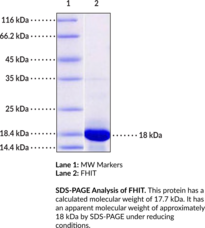
Fragile histidine triad diadenosine triphosphatase (FHIT) is a hydrolase and tumor suppressor.1,2,3 It contains a His-x-His-x-His motif that hydrolyzes diadenosine triphosphate (Ap3A), as well as Ap4A and ATP.1 FHIT is expressed in spleen, brain, kidney, lung, and liver and localizes to the plasma membrane, nucleus, mitochondria, and cytoplasm.4,5,6 It is involved in tumor suppression and genome stability.2 Overexpression of FHIT induces apoptosis in lung cancer cells and reduces tumor growth in lung cancer mouse xenograft models.7 Homozygous or heterozygous loss of FHIT expression is prevalent in several cancers, and the FHIT gene contains a common fragile site, FRA3B, that is a translocation breakpoint associated with hereditary kidney cancer.3 Cayman’s FHIT (human, recombinant) protein consists of 153 amino acids and has a calculated molecular weight of 17.7 kDa. By SDS-PAGE, under reducing conditions, the apparent molecular mass of the protein is 18 kDa.
WARNING This product is not for human or veterinary use.
References & Product Citations
1. Structure-
2. The FHIT gene product: Tumor suppressor and genome "caretaker". Cell. Mol. Life Sci. 71(23), 4577-4587 (2014).
3. FHIT as tumor suppressor: Mechanisms and therapeutic opportunities. Cancer Biol. Ther. 1(3), 232-236 (2002).
4. Distribution of Fhit protein in rat tissues and its intracellular localization. Mol. Cell. Biochem. 266(1-2), 49-55 (2001).
5. Mitochondrial location of rat liver dinucleoside triphosphatase. The Journal of Biological Chemisty 261(5), 2064-2067 (1986).
6. Dinucleosidetriphosphatase from rat liver. Purification and properties. Eur. J. Biochem. 76(2), 331-337 (1977).
7. Induction of apoptosis and inhibition of tumorigenicity and tumor growth by adenovirus vector-
Contact Info
Cayman Chemical1180 East Ellsworth RoadAnn Arbor, Michigan 48108 USAToll Free: (800) 364-9897(USA and Canada only)Fax: (734) 971-3640


