
Technical Support & Resources
Visit our FAQ
Contact Us
Toll Free Phone (USA and Canada Only): (888) 526-5351
Direct Phone: (734) 975-3888
Product Categories
Product Type
ISG15 (mature form) (human, recombinant)
Item No. 35599
Technical Information
- Interferon-induced 15 kDa Protein
- Interferon-induced 17 kDa Protein
- Interferon-stimulated Gene 15
- IP17
- Ubiquitin Cross-reactive Protein
- Ubiquitin-like Protein ISG15
- UCRP
Shipping & Storage Information
Recommended Products
Certificates of Analysis & Batch Specific Data
Provide batch numbers separated by commas to download or request available product inserts, QC sheets, certificates of analysis, data packs, and GC-MS data.
Neutrophil Biology Wall Poster
Explore how neutrophils shape the immune response in health and disease. This poster highlights neutrophil pathogen defense mechanisms, including phagocytosis, degranulation, and NETosis, as well as neutrophil roles in inflammation and NET-associated pathologies.
DOWNLOAD NOWProduct Description
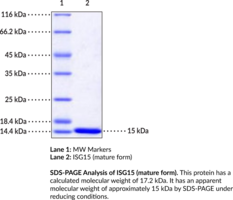
Interferon-stimulated gene 15 (ISG15) is a ubiquitin-like (Ubl) protein found only in vertebrates.1,2 The mature form of ISG15 is composed of an N-terminal Ubl and a C-terminal Ubl with an LRLRGG conjugation sequence at the C-terminus.2 It is expressed in lymphoid cells, epithelial cells, neurons, and skeletal and smooth muscle, and its expression is induced by type I interferon signaling in response to viral or bacterial infection but is also induced in response to the aging process and certain diseases.3,1,2 ISG15 is primarily localized intracellularly conjugated to lysine residues in newly synthesized proteins via ISGylation, a process that can enhance antiviral responses.1 It also exists in a free form that can be secreted by a variety of cells, including fibroblasts, monocytes, and lymphocytes, and binds to the adhesion molecule lymphocyte function-associated antigen-1 (LFA-1) on leukocytes to increase the secretion of IFN-γ. ISG15 can ISGylate viral proteins to prevent viral replication and inhibit the function of viral proteins, however ISGylation on host proteins can be reversed by certain viruses, including severe acute respiratory coronavirus 2 (SARS-CoV-2), leading to suppression of the host innate immune response.1,4,5 Patients deficient in functional ISG15 due to inherited mutations in ISG15 are more resistant to viral infection, but have an increased susceptibility to mycobacterial infection, while Isg15 knockout mice are more susceptible to viral infection, indicating species-specific differences.6,7 Cayman’s ISG15 (mature form) (human, recombinant) protein consists of 157 amino acids and has a calculated molecular weight of 17.2 kDa. By SDS-PAGE, under reducing conditions, the apparent molecular mass of the protein is 15 kDa.
WARNING This product is not for human or veterinary use.
References & Product Citations
1. ISG15: It’s complicated. J. Mol. Biol. 431(21), 4203-4216 (2019).
2. Interferon-
3. Immunohistochemical localization of ubiquitin cross-
4. Characterization and noncovalent inhibition of the deubiquitinase and deISGylase activity of SARS-
5. Papain-
6. ISG15 deficiency and increased viral resistance in humans but not mice. Nat. Commun. 7, 11496 (2016).
7. Mycobacterial disease and impaired IFN-
Contact Info
Cayman Chemical1180 East Ellsworth RoadAnn Arbor, Michigan 48108 USAToll Free: (800) 364-9897(USA and Canada only)Fax: (734) 971-3640


