
Technical Support & Resources
Visit our FAQ
Contact Us
Toll Free Phone (USA and Canada Only): (888) 526-5351
Direct Phone: (734) 975-3888
Product Categories
Technical Information
- NT5E
Shipping & Storage Information
Recommended Products
Certificates of Analysis & Batch Specific Data
Provide batch numbers separated by commas to download or request available product inserts, QC sheets, certificates of analysis, data packs, and GC-MS data.

Visit Our Cancer Resource Center
Find Tools & Resources to Study the Hallmarks of Cancer
- Cancer cell signaling & regulation
- Cancer metabolism
- Tumor microenvironment
Product Description
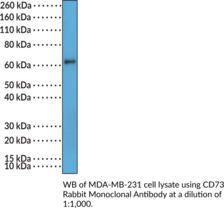
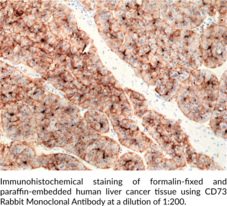
CD73, also known as ecto-5'-nucleotidase, is a membrane-bound ectoenzyme that catalyzes the hydrolysis of AMP to adenosine, a mediator of purinergic signaling pathways.1,2 It exists as a homodimer where each monomer is composed of a catalytic N-terminal domain, a C-terminal substrate-binding domain, and a glycosylphosphatidylinositol (GPI) anchor that is attached to the cell membrane.1 CD73 is ubiquitously expressed, and a soluble form of CD73 (sCD73) can be produced by proteolytic cleavage of its GPI anchor.1 It is upregulated by hypoxia and a variety of pro-inflammatory mediators, including TGF-β, IFN, TNF-α, IL-1β, and prostaglandin E2 (PGE2).3 The enzymatic activity of CD73 is coupled to CD39, the enzyme that produces AMP from ATP, a danger signal produced from injured or dying cells.2 CD73 converts AMP to adenosine, a ligand for adenosine receptors, which regulate various physiological responses, including inflammatory pathways.2,3 It has other immunoregulatory functions, including acting as a T cell co-stimulatory molecule, inhibiting macrophage-mediated inflammation, and facilitating lymphocyte tethering to the endothelium.2 CD73 has additional roles in the maintenance of tissue barrier function, cardioprotection during ischemia-reperfusion injury, and cancer, where it promotes metastasis, angiogenesis, and immune evasion.4 Increased tumor CD73 expression is associated with poor overall survival in patients with breast or ovarian cancer.5 Cayman's Ecto-5'-nucleotidase/CD73 Rabbit Monoclonal Antibody (Clone RM431) can be used for immunohistochemistry (IHC) and Western blot (WB) applications.
WARNING This product is not for human or veterinary use.
References & Product Citations
1. Small-
2. Cell type-
3. CD39 and CD73 in immunity and inflammation. Trends Mol. Med. 19(6), 355-367 (2013).
4. The roles of CD73 in cancer. Biomed. Res. Int. 460654 (2014).
5. Targeting the immunomodulatory CD73/adenosine system to improve the therapeutic gain of radiotherapy. Front. Immunol. 10, 698 (2019).
Contact Info
Cayman Chemical1180 East Ellsworth RoadAnn Arbor, Michigan 48108 USAToll Free: (800) 364-9897(USA and Canada only)Fax: (734) 971-3640


