
Technical Support & Resources
Visit our FAQ
Contact Us
Toll Free Phone (USA and Canada Only): (888) 526-5351
Direct Phone: (734) 975-3888
Product Categories
Product Type
Application
Technical Information
- CD62 Antigen-like Family Member L
- LAM1
- LECAM1
- Leukocyte-endothelial Cell Adhesion Molecule 1
Shipping & Storage Information
Recommended Products
Certificates of Analysis & Batch Specific Data
Provide batch numbers separated by commas to download or request available product inserts, QC sheets, certificates of analysis, data packs, and GC-MS data.
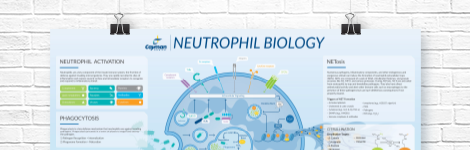
Neutrophil Biology Wall Poster
Explore how neutrophils shape the immune response in health and disease. This poster highlights neutrophil pathogen defense mechanisms, including phagocytosis, degranulation, and NETosis, as well as neutrophil roles in inflammation and NET-associated pathologies.
DOWNLOAD NOWProduct Description
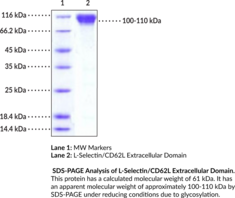
L-Selectin, also known as CD62L, is a glycoprotein and cell adhesion molecule that is encoded by the SELL gene in humans.1,2 It is composed of an N-terminal calcium-dependent lectin domain that recognizes glycoproteins, an EGF-like domain, two consensus repeats, a transmembrane domain, and an intracellular C-terminal tail. L-selectin is expressed in leukocytes and localizes to the plasma membrane.3 It also exists as a soluble form that results from alternative splicing of SELL pre-mRNA or by ectodomain shedding via proteolytic cleavage.2 L-selectin facilitates leukocyte rolling on activated vascular endothelium and lymphocyte homing to high endothelial venules of lymph nodes.4 It binds to several glycoproteins containing the sulfated sialyl Lewis X (6-sulfo-sLeX) epitope, including P-selectin glycoprotein ligand-1 (PSGL-1) and glycosylation-dependent cell adhesion molecule-1 (GlyCAM-1).1 Sell-/- mice exhibit a reduction in the lymphocyte count in peripheral lymph nodes, as well as a decrease in neutrophil recruitment in a model of peritonitis induced by thioglycolate.4 Serum levels of soluble L-selectin are lower in patients with sepsis and associated with higher mortality.5 Cayman’s L-Selectin/CD62L Extracellular Domain (mouse, recombinant) protein can be used for cell-based assays. This protein is a disulfide-linked homodimer. The reduced monomer, composed of L-selectin (amino acids 1-332) fused to His-tagged human IgG1 at its C-terminus, consists of 542 amino acids, has a calculated molecular weight of 61 kDa, and a predicted N-terminus of Trp39 after signal peptide cleavage. As a result of glycosylation, the monomer migrates at approximately 100-110 kDa by SDS-PAGE under reducing conditions.
WARNING This product is not for human or veterinary use.
References & Product Citations
1. Selectins-
2. L-
3. L-
4. Lymphocyte homing and leukocyte rolling and migration are impaired in L-
5. Soluble L-
Contact Info
Cayman Chemical1180 East Ellsworth RoadAnn Arbor, Michigan 48108 USAToll Free: (800) 364-9897(USA and Canada only)Fax: (734) 971-3640


