
Technical Support & Resources
Visit our FAQ
Contact Us
Toll Free Phone (USA and Canada Only): (888) 526-5351
Direct Phone: (734) 975-3888
Product Categories
Scavenger Receptor B2/CD36 Extracellular Domain (mouse, recombinant)
Item No. 35729
Technical Information
- Fatty Acid Translocase
- GPIIIB
- GPIV
- PAS IV
- Platelet Glycoprotein 4
- Platelet Glycoprotein IV
Shipping & Storage Information
Recommended Products
Certificates of Analysis & Batch Specific Data
Provide batch numbers separated by commas to download or request available product inserts, QC sheets, certificates of analysis, data packs, and GC-MS data.
Lipid Resource Center
Discover Products & Resources for Lipid Research
- High-purity lipid standards
- Lipid roles in biology
- Lipids in health & disease
- Lipids for pharmaceutical development
- Protocols, advice, & resources
Product Description
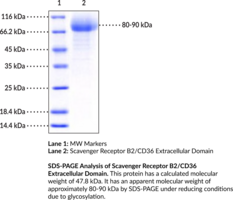
CD36, also known as scavenger receptor B2 or fatty acid translocase, is a transmembrane glycoprotein that has roles in fatty acid uptake and lipid metabolism and signaling.1 It is composed of N- and C-terminal cytoplasmic tails, two transmembrane domains, and an extracellular loop that binds to a variety of lipid ligands, including long-chain fatty acids, oxidized LDL, and oxidized phospholipids, and protein ligands, such as thrombospondin (TSP-1), and is subject to post-translational modifications.1,2,3 CD36 is expressed by a variety of cells, including hematopoietic cells such as platelets, monocytes, and macrophages, as well as adipocytes, enterocytes, cardiac and skeletal myocytes, and endothelial and epithelial cells.1,4 It also exists as a soluble form, sCD36, which is produced via plasma proteases.2 CD36 expression is regulated by several transcription factors, including peroxisome proliferator-activated receptor (PPAR), STAT3, and hypoxia-inducible factor-1α (HIF-1α), in a tissue-dependent manner.3,1 It is localized to the plasma membrane and within endosomes, the endoplasmic reticulum, and mitochondria, and is translocated between these compartments in response to various stimuli, including insulin-induced PI3K signaling and muscle contraction-induced AMPK signaling, to regulate fatty acid uptake.2,3 It has additional roles in the phagocytosis of apoptotic cells and P. falciparum-infected red blood cells (RBCs), angiogenesis, thrombosis, inflammation, and atherosclerosis, as well as cancer metastasis.5,3 Cayman’s Scavenger Receptor B2/CD36 Extracellular Domain (mouse, recombinant) protein can be used for binding assays. This protein consists of 421 amino acids and has a calculated molecular weight of 47.8 kDa. By SDS-PAGE, under reducing conditions, the apparent molecular mass of the protein is 80-90 kDa due to glycosylation.
WARNING This product is not for human or veterinary use.
References & Product Citations
1. Dynamic role of the transmembrane glycoprotein CD36 (SR-
2. CD36 tango in cancer: Signaling pathways and functions. Theranostics 9(17), 4893-4908 (2019).
3. CD36 in chronic kidney disease: Novel insights and therapeutic opportunities. Nat. Rev. Nephrol. 13(12), 769-781 (2017).
4. From fat to FAT (CD36/SR-
5. The CD36-
Contact Info
Cayman Chemical1180 East Ellsworth RoadAnn Arbor, Michigan 48108 USAToll Free: (800) 364-9897(USA and Canada only)Fax: (734) 971-3640


