
Technical Support & Resources
Visit our FAQ
Contact Us
Toll Free Phone (USA and Canada Only): (888) 526-5351
Direct Phone: (734) 975-3888
Product Categories
Technical Information
- Aggrus
- gp38
- T1A
Shipping & Storage Information
Recommended Products
Certificates of Analysis & Batch Specific Data
Provide batch numbers separated by commas to download or request available product inserts, QC sheets, certificates of analysis, data packs, and GC-MS data.

Visit Our Cancer Resource Center
Find Tools & Resources to Study the Hallmarks of Cancer
- Cancer cell signaling & regulation
- Cancer metabolism
- Tumor microenvironment
Product Description
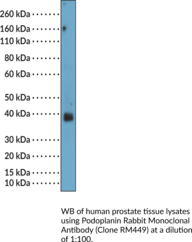
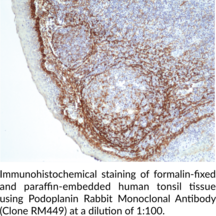
Podoplanin is a transmembrane glycoprotein that has roles in development, immunology, and cancer.1,2 It is composed of a glycosylated extracellular domain, which is critical for podoplanin-induced platelet activation, a single transmembrane region that associates with CD9 and CD44, and a short cytoplasmic tail that interacts with the ezrin-radixin-moesin (ERM) family of proteins to promote rearrangement of the actin cytoskeleton, as well as the epithelial-to-mesenchymal transition (EMT) during embryonic development.2 Podoplanin is expressed in various tissues during murine embryonic development but is predominantly restricted to stromal, lymphatic endothelial, and immune cells, lymphoid organs, and the heart and choroid plexus in the adult mouse.1,2 Its expression is upregulated by various pro-inflammatory cytokines, including IL-22, IL-6, IFN-γ, and TGF-β, and is increased in T cells, fibroblasts, and macrophages during inflammation. It localizes to the cell surface within lipid rafts where it interacts with numerous proteins to modulate cell adhesion and motility.1 Podoplanin binds to C-type lectin receptor 2 (CLEC-2), which is expressed on platelets, to induce platelet aggregation and activation, an effect that is inhibited by the interaction of podoplanin with CD9. Mice implanted with MCF-7 cells overexpressing podoplanin exhibit reduced primary tumor growth but enhanced tumor lymphangiogenesis and lymph node metastasis.3 Tumor podoplanin expression is associated with reduced overall survival in patients with oral squamous cell carcinoma (OSCC).4 Cayman’s Podoplanin Rabbit Monoclonal Antibody (Clone RM449) can be used for immunohistochemistry (IHC) and Western blot (WB) applications.
WARNING This product is not for human or veterinary use.
References & Product Citations
1. Podoplanin: Emerging functions in development, the immune system, and cancer. Front. Immunol. 3, 283 (2012).
2. Podoplanin in inflammation and cancer. Int. J. Mol. Sci. 20(3), 707 (2019).
3. Tumor lymphangiogenesis and metastasis to lymph nodes induced by cancer cell expression of podoplanin. Am. J. Pathol. 177(2), 1004-1016 (2010).
4. Impact of podoplanin expression in oral squamous cell carcinoma: Clinical and histopathologic correlations. Virchows Arch. 456(5), 473-482 (2010).
Contact Info
Cayman Chemical1180 East Ellsworth RoadAnn Arbor, Michigan 48108 USAToll Free: (800) 364-9897(USA and Canada only)Fax: (734) 971-3640


