
Technical Support & Resources
Visit our FAQ
Contact Us
Toll Free Phone (USA and Canada Only): (888) 526-5351
Direct Phone: (734) 975-3888
Product Categories
Product Type
Technical Information
- NTEF-1
- SV40
- TEA Domain Family Member 1
- TEA Domain Transcriptional Factor 1
- TEF-1
- Transcriptional Enhancer Factor 1
Shipping & Storage Information
Recommended Products
Certificates of Analysis & Batch Specific Data
Provide batch numbers separated by commas to download or request available product inserts, QC sheets, certificates of analysis, data packs, and GC-MS data.
Lipid Resource Center
Discover Products & Resources for Lipid Research
- High-purity lipid standards
- Lipid roles in biology
- Lipids in health & disease
- Lipids for pharmaceutical development
- Protocols, advice, & resources
Product Description
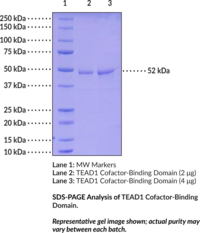
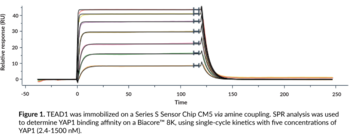
TEA domain transcription factor 1 (TEAD1) is a transcription factor and member of the TEA domain-containing family of transcription factors.1 It is composed of an N-terminal TEA DNA-binding domain, a hydrophobic proline-rich domain, and a C-terminal cofactor-binding domain (CBD), which binds TAZ, YES-associated transcriptional regulator (YAP), vestigial-like proteins (VGLLs), and several other cofactors. Lipidation of the TEAD1 CBD increases TAZ- or YAP-dependent transcriptional activity.2 TEAD1 is expressed in late embryonic development and adult tissues.3 It is involved in the Hippo signaling pathway, which regulates embryonic and organ development, proliferation, and cell death.1 TEAD1 is specifically involved in cardiomyocyte and vascular smooth muscle cell proliferation, myogenesis, gliosis, osteoclastogenesis, and progenitor stemness, among other processes.4,5 TEAD1 containing a tyrosine-to-histidine mutation at position 421 (TEAD1Y421H) is associated with Sveinsson’s chorioretinal atrophy.6 Increased nuclear tumor levels of TEAD1 are associated with decreased disease-free survival in patients with pancreatic ductal adenocarcinoma (PDAC).7 Cayman’s TEAD1 Cofactor-Binding Domain (human, recombinant) protein can be used for binding assays.
WARNING This product is not for human or veterinary use.
References & Product Citations
1. An evolutionary, structural and functional overview of the mammalian TEAD1 and TEAD2 transcription factors. Gene 591(1), 292-303 (2016).
2. Lysine long-
3. Regulation of gene expression at the beginning of mammalian development and the TEAD family of transcription factors. Dev Genet. 22(1), 43-55 (1998).
4. TEAD family transcription factors in development and disease. Development 148(12), dev196675 (2021).
5. VGLL3 operates via TEAD1, TEAD3 and TEAD4 to influence myogenesis in skeletal muscle. J. Cell Sci. 132(13), jcs225946 (2019).
6. A novel TEAD1 mutation is the causative allele in Sveinsson’s chorioretinal atrophy (helicoid peripapillary chorioretinal degeneration). Hum. Mol. Genet. 13(9), 975-981 (2004).
7. Association of subcellular localization of TEAD transcription factors with outcome and progression in pancreatic ductal adenocarcinoma. Pancreatology 21(1), 170-179 (2021).
Contact Info
Cayman Chemical1180 East Ellsworth RoadAnn Arbor, Michigan 48108 USAToll Free: (800) 364-9897(USA and Canada only)Fax: (734) 971-3640


