
Technical Support & Resources
Visit our FAQ
Contact Us
Toll Free Phone (USA and Canada Only): (888) 526-5351
Direct Phone: (734) 975-3888
Product Categories
Product Type
Application
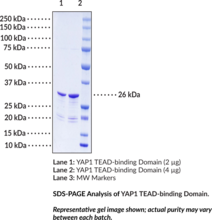
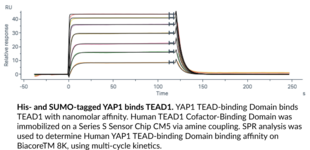
Technical Information
- Protein Yorkie Homolog
- Transcriptional Coactivator YAP1
- Yes-associated Protein 1
- Yes-associated Protein YAP65 Homolog
- Yes1-associated Transcriptional Regulator
Shipping & Storage Information
Recommended Products
Certificates of Analysis & Batch Specific Data
Provide batch numbers separated by commas to download or request available product inserts, QC sheets, certificates of analysis, data packs, and GC-MS data.

Visit Our Cancer Resource Center
Find Tools & Resources to Study the Hallmarks of Cancer
- Cancer cell signaling & regulation
- Cancer metabolism
- Tumor microenvironment
Product Description
Yes1-associated transcriptional regulator (YAP1) is a transcriptional coactivator and member of the Hippo signaling pathway with roles in development, stem cell maintenance, and tissue homeostasis and regulation.1,2 It is composed of an N-terminal proline-rich region and TEAD-binding domain, a WW domain, and a C-terminal transactivation domain.1 YAP1 is ubiquitously expressed and localizes to both the cytoplasm and nucleus. During tissue homeostasis, YAP1 activity is suppressed to maintain stem cell quiescence, but it is de-repressed during injury to facilitate stem cell self-renewal and tissue repair via interaction with various signaling pathways, including Wnt, TGF-β, and EGF.2,3 YAP1 has both pro- and anti-apoptotic functions attributed to the interaction of its WW domain with the tumor suppressors p63 and p73 and the interaction of its N-terminal domain with TEAD transcription factors, respectively.4,5 Mutation of YAP1 at serine 127 prevents YAP1 phosphorylation and increases nuclear retention of YAP1, inducing ferroptosis in cancer cells.6 Homozygous deletion of Yap1 is embryonically lethal in mice.2 Various YAP1 fusion proteins, all of which retain the TEAD-binding domain and exhibit constitutive nuclear localization, are associated with lung adenocarcinoma, cervical carcinoma, breast invasive carcinoma, or skin cutaneous melanoma and with tumor progression.7,8,9 Cayman’s YAP1 TEAD-binding Domain (human, recombinant) protein can be used for binding assay and Western blot (WB) applications.
WARNING This product is not for human or veterinary use.
References & Product Citations
1. The mammalian Hippo pathway: Regulation and function of YAP1 and TAZ. Cell Mol. Life Sci. 72(2), 285-306 (2015).
2. YAP1 and its fusion proteins in cancer initiation, progression and therapeutic resistance. Dev. Biol. 475, 205-221 (2021).
3. The Hippo pathway in tissue homeostasis and regeneration. Protein Cell 8(5), 349-359 (2017).
4. The transcriptional coactivator Yes-
5. TEAD mediates YAP-
6. Transcription factors in ferroptotic cell death. Cancer Gene Ther. 27(9), 645-656 (2020).
7. TumorFusions: An integrative resource for cancer-
8. YAP1 subgroup supratentorial ependymoma requires TEAD and nuclear factor I-
9. Comparison of tumor-
Contact Info
Cayman Chemical1180 East Ellsworth RoadAnn Arbor, Michigan 48108 USAToll Free: (800) 364-9897(USA and Canada only)Fax: (734) 971-3640


