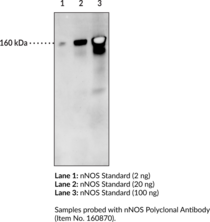
A standard for electrophoresis
Technical Support & Resources

Visit our FAQ

Contact Us

Toll Free Phone (USA and Canada Only): (888) 526-5351
Direct Phone: (734) 975-3888

Request Technical Support

Technical Support Request

To streamline the process attach the appropriate questionnaire to your inquiry.

Download IHC QuestionnaireDownload WB Questionnaire

View Our Privacy Statement for details on how we use and protect your data. In addition, this site is protected by hCaptcha and its Privacy Policy and Terms of Service apply.

nNOS Electrophoresis Standard

Item No. 360870

Technical Information
Synonyms
  • Neuronal Nitric Oxide Synthase
  • NOS I
  • ncNOS
Purity
≥95%
Source
Isolated from a Baculovirus overexpression system in Sf9 cells
MW
160.00
5 μg purified nNOS
Storage Buffer
50 μl of 50 mM HEPES buffer, pH 7.4, with 20% glycerol
Applications
Western blot and gel staining; this enzyme may not be catalytically active
Shipping & Storage Information
Storage
-80°C
Shipping
Dry ice in continental US; may vary elsewhere
Recommended Products

Certificates of Analysis & Batch Specific Data

Provide batch numbers separated by commas to download or request available product inserts, QC sheets, certificates of analysis, data packs, and GC-MS data.

    Add

    Product Description

    Nitric oxide synthase (NOS) catalyzes the oxidation of arginine to nitric oxide (NO) and citrulline. Three distinct isoforms of NOS have been described having nomenclature based on the tissue source from which they were originally cloned. These three isoforms are neuronal/brain NOS (nNOS/bNOS/NOS-I), inducible NOS (iNOS/NOS-II), and endothelial NOS (eNOS/NOS-III).1,2 nNOS is a soluble enzyme found in brain, the peripheral nervous system and skeletal muscle.3,4 An alternately spliced form of nNOS (nNOSμ) containing a 34 amino acid insert has been identified in skeletal muscle.5 In neurons, protein-protein interactions with PSD95 and PSD93 via the PZD domain at the N-terminus of nNOS localizes the enzyme with NMDA receptors.6,7 Although nNOS was originally thought to be constitutively expressed, abundant evidence suggests expression is regulated by a variety of conditions.8

    WARNING This product is not for human or veterinary use.

    References & Product Citations
    Product Description References

    1. Michel, T., Xie, Q.-W., and Nathan, C. Molecular biological analysis of nitric oxide synthases. Methods in nitric oxide research 161-175 (1996).

    2. Michel, T., and Feron, O. Nitric oxide synthases: Which, where, how, and why? J. Clin. Invest. 100(9), 2146-2152 (1997).

    3. Bredt, D.S., Hwang, P.M., Glatt, C.E., et alCloned and expressed nitric oxide synthase structurally resembles cytochrome P-450 reductase. Nature 351(6329), 714-718 (1991).

    4. Nakane, M., Schmidt, H.H.W., Pollock, J.S., et alCloned human brain nitric oxide synthase is highly expressed in skeletal muscle. FEBS Lett. 316(2), 175-180 (1993).

    5. Silvagno, F., Xia, H., and Bredt, D.S. Neuronal nitric-oxide synthase-μ, an alternatively spliced isoform expressed in differentiated skeletal muscle. The Journal of Biological Chemisty 271(19), 11204-11208 (1996).

    6. Brenman, J.E., Christopherson, K.S., Craven, S.E., et alCloning and characterization of postsynaptic density 93, a nitric oxide synthase interacting protein. J. Neurosci. 16(23), 7407-7415 (1996).

    7. Christopherson, K.S., and Bredt, D.S. Nitric oxide in excitable tissues: Physiological roles and disease. J. Clin. Invest. 100(10), 2424-2429 (1997).

    8. Wang, Y., Newton, D.C., and Marsden, P.A. Neuronal NOS: Gene structure, mRNA diversity, and functional relevance. Crit. Rev. Neurobiol. 13(1), 21-43 (1999).