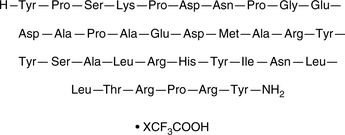
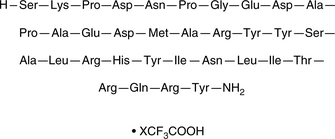
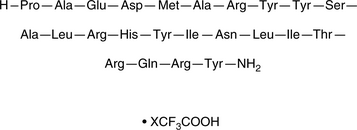
A neuropeptide and an NPY receptor agonist
Technical Support & Resources

Information provided in the product description is from published literature. Due to the nature of scientific experimentation, your results (e.g., selectivity and effective concentrations) or specific application for this product may differ. If you have questions about how this product fits your application, please contact our technical support staff.

Visit our FAQ

Contact Us

Toll Free Phone (USA and Canada Only): (888) 526-5351
Direct Phone: (734) 975-3888

Request Technical Support

Technical Support Request

To streamline the process attach the appropriate questionnaire to your inquiry.

Download IHC QuestionnaireDownload WB Questionnaire

View Our Privacy Statement for details on how we use and protect your data. In addition, this site is protected by hCaptcha and its Privacy Policy and Terms of Service apply.

Neuropeptide Y (porcine, bovine) (trifluoroacetate salt)

Item No. 36715

Technical Information
Formal Name
L-tyrosyl-L-prolyl-L-seryl-L-lysyl-L-prolyl-L-α-aspartyl-L-asparaginyl-L-prolylglycyl-L-α-glutamyl-L-α-aspartyl-L-alanyl-L-prolyl-L-alanyl-L-α-glutamyl-L-α-aspartyl-L-leucyl-L-alanyl-L-arginyl-L-tyrosyl-L-tyrosyl-L-seryl-L-alanyl-L-leucyl-L-arginyl-L-histidyl-L-tyrosyl-L-isoleucyl-L-asparaginyl-L-leucyl-L-isoleucyl-L-threonyl-L-arginyl-L-glutaminyl-L-arginyl- L-tyrosinamide, trifluoroacetate salt
Synonyms
  • NPY (porcine, bovine)
Molecular Formula
C190H287N55O57 • XCF3COOH
Formula Weight
Purity
≥98%
A solid
Peptide Sequence
YPSKPDNPGEDAPAEDLARYYSALRHYINLITRQRY-NH2
DMF: 30 mg/mlDMSO: 30 mg/mlEthanol: 2 mg/mlPBS (pH 7.2): Slightly soluble
SMILES
[H]NCCCC[C@H](NC([C@H](CO)NC([C@@H]1CCCN1C([C@H](CC2=CC=C(O)C=C2)N[H])=O)=O)=O)C(N3CCC[C@H]3C(N[C@@H](CC(O)=O)C(N[C@@H](CC(N)=O)C(N4CCC[C@H]4C(NCC(N[C@@H](CCC(O)=O)C(N[C@@H](CC(O)=O)C(N[C@H](C(N5CCC[C@H]5C(N[C@H](C(N[C@@H](CCC(O)=O)C(N[C@@H](CC(O)=O)C(N[C@H](C(N[C@H](C(N[C@@H](CCCNC(N)=N)C(N[C@@H](CC(C=C6)=CC=C6O)C(N[C@@H](CC(C=C7)=CC=C7O)C(N[C@@H](CO)C(N[C@H](C(N[C@H](C(N[C@@H](CCCNC(N)=N)C(N[C@@H](CC8=CNC=N8)C(N[C@@H](CC(C=C9)=CC=C9O)C(N[C@@](C(N[C@@H](CC(N)=O)C(N[C@H](C(N[C@@](C(N[C@@]([H])([C@@H](C)O)C(N[C@@H](CCCNC(N)=N)C(N[C@@H](CCC(N)=O)C(N[C@@H](CCCNC(N)=N)C(N[C@@H](CC(C=C%10)=CC=C%10O)C(N)=O)=O)=O)=O)=O)=O)([H])[C@H](CC)C)=O)CC(C)C)=O)=O)([H])[C@H](CC)C)=O)=O)=O)=O)CC(C)C)=O)C)=O)=O)=O)=O)=O)C)=O)CC(C)C)=O)=O)=O)C)=O)=O)C)=O)=O)=O)=O)=O)=O)=O)=O.OC(C(F)(F)F)=O
InChi Code
InChI=1S/C190H287N55O57.C2HF3O2/c1-16-94(9)149(180(296)235-129(81-141(194)255)169(285)227-124(74-93(7)8)172(288)240-150(95(10)17-2)181(297)241-151(100(15)248)182(298)222-116(32-23-67-209-190(203)204)156(272)221-118(57-60-140(193)254)161(277)219-114(30-21-65-207-188(199)200)157(273)224-121(152(196)268)76-102-39-49-108(250)50-40-102)239-173(289)127(79-105-45-55-111(253)56-46-105)230-168(284)128(80-106-86-205-90-211-106)231-159(275)115(31-22-66-208-189(201)202)220-165(281)123(73-92(5)6)225-155(271)97(12)213-174(290)134(88-246)237-167(283)126(78-104-43-53-110(252)54-44-104)229-166(282)125(77-103-41-51-109(251)52-42-103)228-158(274)113(29-20-64-206-187(197)198)217-153(269)96(11)212-163(279)122(72-91(3)4)226-170(286)131(84-147(264)265)233-162(278)119(59-62-145(260)261)218-154(270)98(13)214-177(293)137-34-25-68-242(137)183(299)99(14)215-164(280)130(83-146(262)263)232-160(276)117(58-61-144(258)259)216-143(257)87-210-176(292)136-33-24-70-244(136)186(302)133(82-142(195)256)236-171(287)132(85-148(266)267)234-178(294)139-36-27-71-245(139)185(301)120(28-18-19-63-191)223-175(291)135(89-247)238-179(295)138-35-26-69-243(138)184(300)112(192)75-101-37-47-107(249)48-38-101;3-2(4,5)1(6)7/h37-56,86,90-100,112-139,149-151,246-253H,16-36,57-85,87-89,191-192H2,1-15H3,(H2,193,254)(H2,194,255)(H2,195,256)(H2,196,268)(H,205,211)(H,210,292)(H,212,279)(H,213,290)(H,214,293)(H,215,280)(H,216,257)(H,217,269)(H,218,270)(H,219,277)(H,220,281)(H,221,272)(H,222,298)(H,223,291)(H,224,273)(H,225,271)(H,226,286)(H,227,285)(H,228,274)(H,229,282)(H,230,284)(H,231,275)(H,232,276)(H,233,278)(H,234,294)(H,235,296)(H,236,287)(H,237,283)(H,238,295)(H,239,289)(H,240,288)(H,241,297)(H,258,259)(H,260,261)(H,262,263)(H,264,265)(H,266,267)(H4,197,198,206)(H4,199,200,207)(H4,201,202,208)(H4,203,204,209);(H,6,7)/t94-,95-,96-,97-,98-,99-,100+,112-,113-,114-,115-,116-,117-,118-,119-,120-,121-,122-,123-,124-,125-,126-,127-,128-,129-,130-,131-,132-,133-,134-,135-,136-,137-,138-,139-,149-,150-,151-;/m0./s1
InChi Key
IGEZIIGYHHEFBI-ZWYMSMRWSA-N
Shipping & Storage Information
Storage
-20°C
Shipping
Room temperature in continental US; may vary elsewhere
Recommended Products

Certificates of Analysis & Batch Specific Data

Provide batch numbers separated by commas to download or request available product inserts, QC sheets, certificates of analysis, data packs, and GC-MS data.

    Add

    Add

    Add

    Add

    Product Description

    Neuropeptide Y (NPY) is a neuropeptide involved in appetite, vasoconstriction, cardiac contractility, and intestinal secretion and an agonist of the NPY receptors Y1, Y2, and Y5.1,2 It is expressed throughout the body.1 NPY selectively inhibits forskolin-induced cAMP accumulation in L-M(TK-) cells expressing rat Y1 or Y2 and HEK293 cells expressing rat Y5 over L-M(TK-) cells expressing rat Y4 receptors (EC50s = 0.15, 2.7, 0.66, and >1,000 nM, respectively).2 It increases perfusion pressure in isolated guinea pig heart (EC30 = 1.3 nM).3 Intracerebroventricular administration of NPY (300 pmol/animal) increases food intake in rats.2

    WARNING This product is not for human or veterinary use.

    References & Product Citations
    Product Description References

    1. Balasubramaniam, A. Neuropeptide Y family of hormones: Receptor subtypes and antagonists. Peptides 18(3), 445-457 (1997).

    2. Gerald, C., Walker, M.W., Criscione, L., et alA receptor subtype involved in neuropeptide-Y-induced food intake. Nature 382(6587), 168-171 (1996).

    3. Rioux, F., Bachelard, H., Martel, J.-C., et alThe vasoconstrictor effect of neuropeptide Y and related peptides in the guinea pig isolated heart. Peptides 7(1), 27-31 (1986).