
Technical Support & Resources
Visit our FAQ
Contact Us
Toll Free Phone (USA and Canada Only): (888) 526-5351
Direct Phone: (734) 975-3888
Product Categories
AcMNPV Major Envelope Glycoprotein Neutralizing Antibody (Clone M001)
Item No. 37014
Technical Information
- AcMNPV GP64
- Autographa californica Multicapsid Nucleopolyhedrovirus Major Envelope Glycoprotein
- Autographa californica Multiple Nucleopolyhedrovirus Major Envelope Glycoprotein
Shipping & Storage Information
Recommended Products
Certificates of Analysis & Batch Specific Data
Provide batch numbers separated by commas to download or request available product inserts, QC sheets, certificates of analysis, data packs, and GC-MS data.
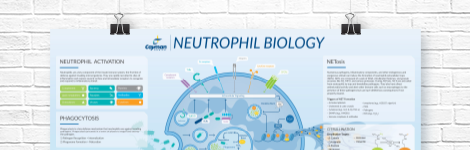
Neutrophil Biology Wall Poster
Explore how neutrophils shape the immune response in health and disease. This poster highlights neutrophil pathogen defense mechanisms, including phagocytosis, degranulation, and NETosis, as well as neutrophil roles in inflammation and NET-associated pathologies.
DOWNLOAD NOWProduct Description
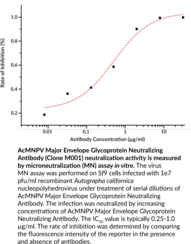
Autographa californica multiple nucleopolyhedrovirus (AcMNPV) major envelope glycoprotein is a class III viral fusion protein.1 AcMNPV is a double-stranded DNA insect virus and member of the Baculoviridae family. AcMNPV major envelope glycoprotein exists as a trimer and is composed of five domains in the low pH, post-fusion state that is highly post-translationally modified via glycosylation sites and a palmitoylation site at the C-terminus.2,3 It is expressed on the surface of infected cells and budded virions.1 AcMNPV major envelope glycoprotein is involved in viral envelope-host cell endosome membrane fusion in a low pH-dependent manner and in virion budding.4,5 Lipoplexes containing AcMNPV major envelope glycoprotein have been used for gene delivery to mammalian cells, which can be inhibited by an AcMNPV major envelope glycoprotein neutralizing antibody.6 Cayman’s AcMNPV Major Envelope Glycoprotein Neutralizing Antibody (Clone M001) can be used for microneutralization (MN) assays.
WARNING This product is not for human or veterinary use.
References & Product Citations
1. Critical residues and contacts within domain IV of Autographa californica multiple nucleopolyhedrovirus GP64 contribute to its refolding during membrane fusion. J. Virol. 94(19), e01105-01120 (2020).
2. The postfusion structure of baculovirus GP64 supports a unified view of viral fusion machines. Nat. Struct. Mol. Biol. 15(10), 1024-1030 (2008).
3. Palmitoylation of the Autographa californica multicapsid nucleopolyhedrovirus envelope glycoprotein GP64: Mapping, functional studies, and lipid rafts. J. Virol. 77(11), 6265-6273 (2003).
4. The major hurdle for effective baculovirus transduction into mammalian cells is passing early endosomes. J. Virol. 93(15), e00709-00719 (2019).
5. Requirement for GP64 to drive efficient budding of Autographa californica multicapsid nucleopolyhedrovirus. Virology 254(2), 297-314 (1999).
6. Characterization of the gene delivery properties of baculoviral-
Contact Info
Cayman Chemical1180 East Ellsworth RoadAnn Arbor, Michigan 48108 USAToll Free: (800) 364-9897(USA and Canada only)Fax: (734) 971-3640


