
Technical Support & Resources
Visit our FAQ
Contact Us
Toll Free Phone (USA and Canada Only): (888) 526-5351
Direct Phone: (734) 975-3888
Product Categories
Technical Information
- Fcgr1
- Fc-γ RIA
- FcγRIa
- FcRI
- High Affinity IgGγ Fc Receptor I
- High Affinity Immunoglobulin Gamma Fc Receptor I
- IgG Fc Receptor I
Shipping & Storage Information
Recommended Products
Certificates of Analysis & Batch Specific Data
Provide batch numbers separated by commas to download or request available product inserts, QC sheets, certificates of analysis, data packs, and GC-MS data.
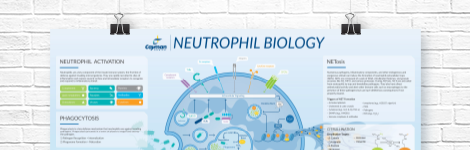
Neutrophil Biology Wall Poster
Explore how neutrophils shape the immune response in health and disease. This poster highlights neutrophil pathogen defense mechanisms, including phagocytosis, degranulation, and NETosis, as well as neutrophil roles in inflammation and NET-associated pathologies.
DOWNLOAD NOWProduct Description
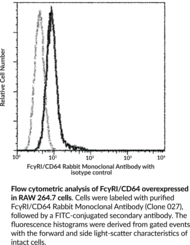
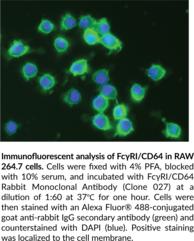
CD64, also known as high-affinity immunoglobulin γ receptor I (FcγRI), is a transmembrane glycoprotein that binds the Fc region of IgG.1 It is composed of a ligand-binding α-chain, which contains three extracellular Ig-like domains, a transmembrane region, and a cytoplasmic domain, and two γ-chains, which contain immunoreceptor tyrosine-based activation motifs (ITAMs) that mediate signal transduction.2,3,4 CD64 is constitutively expressed in myeloid cells, including monocytes and macrophages, but can be induced in neutrophils in response to IFN-γ or G-CSF.5,3 It is involved in phagocytosis, cytokine release, antibody-dependent cell-mediated cytotoxicity (ADCC), and antigen presentation to primed T cells.1,6 Mouse CD64 selectively forms immune complexes with IgG2a, whereas human CD64 forms immune complexes with IgG1, IgG3, and IgG4.1,7 Knockout of Fcgr1, the gene encoding CD64, inhibits clearance of B. pertussis infection in mice.1 Increased serum levels of CD64 are associated with sepsis.8 Cayman’s FcγRI/CD64 Rabbit Monoclonal Antibody (Clone 027) can be used for flow cytometry (FC), immunocytochemistry (ICC), and immunofluorescence (IF) applications.
WARNING This product is not for human or veterinary use.
References & Product Citations
1. FcγRI (CD64) contributes substantially to severity of arthritis, hypersensitivity responses, and protection from bacterial infection. Immunity 16(3), 391-402 (2002).
2. Functional characteristics of the high affinity IgG receptor, FcγRI. J. Immunol. 186(5), 2699-2704 (2011).
3. CD64: An attractive immunotherapeutic target for M1-
4. The diverse functions of the ubiquitous Fcγ receptors and their unique constituent, FcRγ subunit. Pathogens 9(2), 140 (2020).
5. Molecular cloning and expression of the mouse high affinity Fc receptor for IgG. J. Immunol. 144(1), 371-378 (1990).
6. FcγRI-
7. Specificity and affinity of human Fcγ receptors and their polymorphic variants for human IgG subclasses. Blood 113(16), 3716-3725 (2009).
8. CD64 and group II secretory phospholipase A2 (sPLA2-
Contact Info
Cayman Chemical1180 East Ellsworth RoadAnn Arbor, Michigan 48108 USAToll Free: (800) 364-9897(USA and Canada only)Fax: (734) 971-3640


