
Technical Support & Resources
Visit our FAQ
Contact Us
Toll Free Phone (USA and Canada Only): (888) 526-5351
Direct Phone: (734) 975-3888
Technical Information
- Histidine-proline-rich Glycoprotein
- HPRG
- HRG
Shipping & Storage Information
Recommended Products
Certificates of Analysis & Batch Specific Data
Provide batch numbers separated by commas to download or request available product inserts, QC sheets, certificates of analysis, data packs, and GC-MS data.

Visit Our Cancer Resource Center
Find Tools & Resources to Study the Hallmarks of Cancer
- Cancer cell signaling & regulation
- Cancer metabolism
- Tumor microenvironment
Product Description
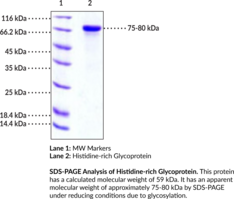
Histidine-rich glycoprotein is an abundant plasma glycoprotein that is involved in diverse biological processes, including angiogenesis, hemostasis, cell adhesion, and immunity.1,2 It is composed of a signal peptide and two cystatin-like regions in the N-terminal domain, a central domain with a histidine-rich region (HRR) and two proline-rich regions (PRRs) on either side, and a C-terminal domain. Histidine-rich glycoprotein is mainly produced by the liver but is also found in platelets and megakaryocytes.3,4 It has many binding partners, including IgG, immunoglobulin γ receptor (FcγR), and complement 1q (C1q), which bind to the N-terminal domain, zinc, heme, and microbes, which bind to the HRR, heparin and heparan sulfate, which bind to the N-terminal domain and HRR, plasminogen and thrombospondin, which bind to the N-terminal and C-terminal domains, and phospholipids, fibrinogen, and complement components, which have undefined binding regions.2 Histidine-rich glycoprotein is also able to bind to various cell types such as T cells, B cells, erythrocytes, endothelial cells, and several cancer types. It modulates macrophage polarization, facilitates the clearance of apoptotic and necrotic cells, promotes antitumor immunity, and has antibacterial and antiviral activities.1,2 Overexpression of HRG decreases tumor burden, metastasis, hypoxia, and blood vessel density and increases tumor-associated macrophage (TAM) accumulation in several mouse xenograft models.5 Increased plasma levels of histidine-rich glycoprotein are associated with the development of post-thrombotic syndrome following a venous thromboembolic event (VTE).6 Cayman's Histidine-rich Glycoprotein (human, recombinant) protein can be used for cell-based adhesion assays. This protein consists of 518 amino acids, has a calculated molecular weight of 59 kDa, and a predicted N-terminus of Val19 after signal peptide cleavage. By SDS-PAGE, under reducing conditions, the apparent molecular mass of the protein is 75-80 kDa due to glycosylation.
WARNING This product is not for human or veterinary use.
References & Product Citations
1. Histidine-
2. Histidine-
3. Amino acid sequence of human histidine-
4. Histidine-
5. HRG inhibits tumor growth and metastasis by inducing macrophage polarization and vessel normalization through downregulation of PlGF. Cancer Cell 19(1), 31-44 (2011).
6. Increased levels of histidine‑rich glycoprotein are associated with the development of post‑thrombotic syndrome. Sci. Rep. 10(1), 14419 (2020).
Contact Info
Cayman Chemical1180 East Ellsworth RoadAnn Arbor, Michigan 48108 USAToll Free: (800) 364-9897(USA and Canada only)Fax: (734) 971-3640


