
Technical Support & Resources
Visit our FAQ
Contact Us
Toll Free Phone (USA and Canada Only): (888) 526-5351
Direct Phone: (734) 975-3888
C-Reactive Protein (human, recombinant)
Item No. 37018
Technical Information
- CRP
Shipping & Storage Information
Recommended Products
Certificates of Analysis & Batch Specific Data
Provide batch numbers separated by commas to download or request available product inserts, QC sheets, certificates of analysis, data packs, and GC-MS data.

Neutrophil Biology Wall Poster
Explore how neutrophils shape the immune response in health and disease. This poster highlights neutrophil pathogen defense mechanisms, including phagocytosis, degranulation, and NETosis, as well as neutrophil roles in inflammation and NET-associated pathologies.
DOWNLOAD NOWProduct Description
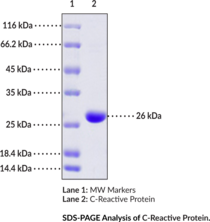
C-Reactive protein (CRP) is an acute phase protein and a member of the pentraxin family.1 It is composed of five protomers arranged symmetrically around a central pore and is primarily expressed in, and secreted by, the liver. CRP modulates endothelial function, increases protein levels of intracellular adhesion molecule-1 (ICAM-1), vascular cell adhesion molecule-1 (VCAM-1), and E-selectin, stimulates coagulation, mediates uptake of LDL into macrophages, and destabilizes atherosclerotic plaques.1,2,3,4,5 In addition, CRP binds to phosphocholine on microbes in a calcium-dependent manner, acts as a ligand for receptors on phagocytic leukocytes, mediates activation of monocytes and macrophages via IL-6 and other cytokines, and assists in the complement pathway.1,6,7 CRP plasma levels increase in response to acute and chronic inflammatory conditions, and high plasma CRP concentrations are associated with an increased risk for atherosclerosis.1,8 Cayman’s C-Reactive Protein (human, recombinant) protein consists of 206 amino acids, has a calculated molecular weight of 23 kDa, and a predicted N-terminus of Gln19 after signal peptide cleavage. By SDS-PAGE, under reducing conditions, the apparent molecular mass of the protein is 26 kDa due to glycosylation.
WARNING This product is not for human or veterinary use.
References & Product Citations
1. Human C-
2. Direct proinflammatory effect of C-
3. Inflammation in cardiovascular disease cart, horse, or both? Circulation 97, 2000-2002 (1998).
4. C-
5. C-
6. C-
7. Complement-
8. Clinical application of C-
Contact Info
Cayman Chemical1180 East Ellsworth RoadAnn Arbor, Michigan 48108 USAToll Free: (800) 364-9897(USA and Canada only)Fax: (734) 971-3640


