
Technical Support & Resources
Visit our FAQ
Contact Us
Toll Free Phone (USA and Canada Only): (888) 526-5351
Direct Phone: (734) 975-3888
Technical Information
- CVID6
- TAPA-1
- Target of Antiproliferative Antibody 1
- TSPAN28
Shipping & Storage Information
Recommended Products
Certificates of Analysis & Batch Specific Data
Provide batch numbers separated by commas to download or request available product inserts, QC sheets, certificates of analysis, data packs, and GC-MS data.

Visit Our Cancer Resource Center
Find Tools & Resources to Study the Hallmarks of Cancer
- Cancer cell signaling & regulation
- Cancer metabolism
- Tumor microenvironment
Product Description
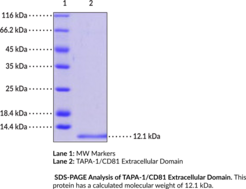
CD81, also known as target of antiproliferative antibody 1 (TAPA-1), is a member of the tetraspanin protein family with roles in B cell biology and T cell activation and as a virus host factor.1,2 It is composed of four transmembrane segments, which are packed as two pairs of helices, and an extracellular loop at the outer membrane leaflet that, unlike other tetraspanin proteins, is non-glycosylated and subject to post-translational acylation.2,3 On the surface of B cells, CD81 associates with CD19 and CD21 to facilitate adhesion and reduce the threshold for B cell receptor activation, as well as with MHC class II molecules as a component of the B cell surface receptor complex.3,4,5 On T cells, CD81 interacts with CD4 and CD8 and functions as a co-stimulator of naïve T cell activation in conjunction with CD3 and CD28.1,6 CD81 also acts as a virus host factor, and neutralization of CD81 with anti-CD81 antibodies reduces HIV-1 replication and inhibits influenza A virus uncoating and viral budding, as well as inhibits coronavirus (CoV) and hepatitis C virus (HCV) cell entry.7 CD81 levels are increased in several lymphoma cell lines, and antibody-driven neutralization of CD81 induces complement-dependent cytotoxicity, antibody-dependent cellular phagocytosis, and cytotoxicity in these cells.5 Cayman’s TAPA-1/CD81 Extracellular Domain (human, recombinant; His-tagged) protein consists of 108 amino acids and has a calculated molecular weight of 12.1 kDa.
WARNING This product is not for human or veterinary use.
References & Product Citations
1. Complementary costimulation of human T-
2. Crystal structure of a full-
3. CD81 (TAPA-
4. Supramolecular complexes of MHC class I, MHC class II, CD20, and tetraspan molecules (CD53, CD81, and CD82) at the surface of a B cell line JY. J. Immunol. 157(7), 2939-2946 (1996).
5. CD81 as target for B cell lymphomas. J. Exp. Med. 216(7), 1469-1470 (2019).
6. CD81 costimulation skews CAR transduction toward naive T cells. Proc. Natl. Acad. Sci. USA 119(5), e1910844119 (2022).
7. Tetraspanins: Host factors in viral infections. Int. J. Mol. Sci. 22(21), 11609 (2021).
Contact Info
Cayman Chemical1180 East Ellsworth RoadAnn Arbor, Michigan 48108 USAToll Free: (800) 364-9897(USA and Canada only)Fax: (734) 971-3640


