
Technical Support & Resources
Visit our FAQ
Contact Us
Toll Free Phone (USA and Canada Only): (888) 526-5351
Direct Phone: (734) 975-3888
Product Categories

Technical Information
- Apolipoprotein J
- ApoJ
- Ku70-binding Protein 1
- SGP-2
- Sulfated Glycoprotein
- Testosterone-repressed Prostate Message 2
- TRPM-2
Shipping & Storage Information
Recommended Products
Certificates of Analysis & Batch Specific Data
Provide batch numbers separated by commas to download or request available product inserts, QC sheets, certificates of analysis, data packs, and GC-MS data.
Product Description
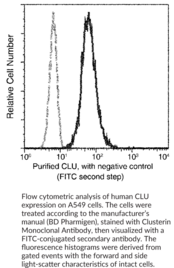
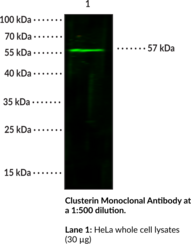
Clusterin is a secreted heterodimeric glycoprotein.1 It is proteolytically processed to remove a signal peptide and cleave the α and β chains.1,2 This cleavage creates small- and medium-sized isoforms found in the nucleus or cytosol and mitochondria, respectively, and a large-sized isoform composed of α- and β chains linked via disulfide bonds near the center that is secreted outside the cell.2 Clusterin is ubiquitously expressed in tissues and found in physiological fluids. It is a multifunctional protein involved in a wide range of processes, including immune modulation, autophagosome formation, apoptosis, and extracellular matrix remodeling, among others.3 Clusterin is upregulated by cellular stress and acts as an extracellular chaperone and scavenger to prevent protein aggregation. SNPs in CLU, the gene encoding clusterin, are associated with a higher rate of cognitive decline in patients with mild cognitive decline or Alzheimer's disease.4 Clusterin is also associated with inflammatory and cardiovascular diseases, where it has either protective or detrimental effects.2 Cayman's Clusterin Monoclonal Antibody (Clone 9E2E2) can be used for flow cytometry (FC), ELISA, immunocytochemistry (ICC), immunofluorescence (IF), and Western blot (WB) applications.
WARNING This product is not for human or veterinary use.
References & Product Citations
1. Molecules in focus: Clusterin. Int. J. Biochem. Cell Biol. 34(5), 427-431 (2002).
2. Clusterin: Always protecting. Synthesis, function and potential issues. Biomed. Pharmacother. 134, 111174 (2021).
3. The CLU-
4. Alzheimer risk variant CLU and brain function during aging. Biol. Psychiatry 73(5), 399-405 (2013).
Contact Info
Cayman Chemical1180 East Ellsworth RoadAnn Arbor, Michigan 48108 USAToll Free: (800) 364-9897(USA and Canada only)Fax: (734) 971-3640


