
Technical Support & Resources
Visit our FAQ
Contact Us
Toll Free Phone (USA and Canada Only): (888) 526-5351
Direct Phone: (734) 975-3888
Product Categories
Application
VE-Cadherin/CD144 Rabbit Monoclonal Antibody (Clone 012)
Item No. 37085
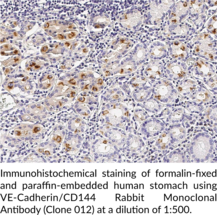
Technical Information
- 7B4 Antigen
- Cadherin-5
- Vascular Endothelial Cadherin
Shipping & Storage Information
Recommended Products
Certificates of Analysis & Batch Specific Data
Provide batch numbers separated by commas to download or request available product inserts, QC sheets, certificates of analysis, data packs, and GC-MS data.

Visit Our Cancer Resource Center
Find Tools & Resources to Study the Hallmarks of Cancer
- Cancer cell signaling & regulation
- Cancer metabolism
- Tumor microenvironment
Product Description
VE-cadherin, also known as CD144, is a type II classical cadherin and member of the cadherin superfamily of calcium-dependent cell adhesion molecules.1 It is composed of an N-terminal signal peptide, a pro-peptide, five extracellular cadherin repeats that bind to homotypic cadherins, a transmembrane domain, and a cytoplasmic tail that interacts with the cytoskeleton. VE-cadherin is endothelial cell-specific and is localized to intracellular junctions where it participates in vascular structure assembly.2,3,4 An anti-VE-cadherin antibody in combination with an anti-CD31 antibody inhibits tube formation in human umbilical vein endothelial cells (HUVECs).5 Knockout of Cdh5, the gene encoding VE-cadherin, in mouse embryonic stem cells prevents the formation of vessel-like structures in 11-day-old embryoid bodies.3 VE-cadherin is overexpressed in melanoma and breast cancer and is positively correlated with poor prognosis.6 Cayman's VE-Cadherin/CD144 Rabbit Monoclonal Antibody (Clone 012) can be used for immunohistochemistry (IHC).
WARNING This product is not for human or veterinary use.
References & Product Citations
1. Cadherin signaling in cancer: Its functions and role as a therapeutic target. Front Oncol. 9, 989 (2019).
2. A novel endothelial-
3. Targeted null-
4. Functional properties of human vascular endothelial cadherin (7B4/cadherin-
5. Endothelial cell tube formation depends on cadherin 5 and CD31 interactions with filamentous actin. J. Immunol. 158(7), 3408-3416 (1997).
6. VE-
Contact Info
Cayman Chemical1180 East Ellsworth RoadAnn Arbor, Michigan 48108 USAToll Free: (800) 364-9897(USA and Canada only)Fax: (734) 971-3640


