
Technical Support & Resources
Visit our FAQ
Contact Us
Toll Free Phone (USA and Canada Only): (888) 526-5351
Direct Phone: (734) 975-3888
Product Categories
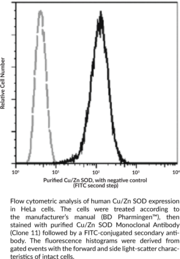
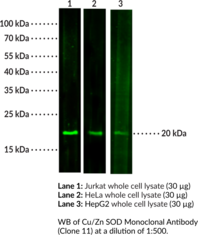
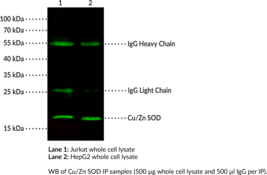
Technical Information
- Cu/Zn Superoxide Dismutase
- SOD1
Shipping & Storage Information
Recommended Products
Certificates of Analysis & Batch Specific Data
Provide batch numbers separated by commas to download or request available product inserts, QC sheets, certificates of analysis, data packs, and GC-MS data.
Product Description
Cu/Zn Superoxide dismutase (Cu/Zn SOD) is an antioxidant enzyme that protects cells from oxidative stress by scavenging superoxide anions.1 It exists as a homodimer that is stabilized by a disulfide bond between the subunits. Each monomer is composed of a Greek key β-barrel and an active site channel made up of a β4/β5 loop, which interacts with the dimer interface and active site zinc, and an electrostatic loop, which facilitates superoxide entry into the copper-containing active site.2 Cu/Zn SOD is ubiquitously expressed and primarily localizes to the cytosol but has also been found in the nucleus, peroxisomes, lysosomes, and the intermembrane space of mitochondria.3,4 It catalyzes the dismutation of superoxide to hydrogen peroxide and oxygen by alternating reduction and reoxidation of copper at the enzyme active site.1 Overexpression of SOD1 protects against increases in reactive oxygen species (ROS) and apoptosis in an in vitro model of renal ischemia induced by ATP depletion.5 In vivo, transgenic mice expressing the destabilized Cu/Zn SODG93A mutation exhibit impaired spinal cord mitochondrial respiration.6,7 Mutations in SOD1 are associated with amyotrophic lateral sclerosis (ALS).8 Cayman’s Cu/Zn SOD Monoclonal Antibody (Clone 11) can be used for flow cytometry (FC), immunoprecipitation (IP), and Western blot (WB) applications.
WARNING This product is not for human or veterinary use.
References & Product Citations
1. Superoxide dismutases: Role in redox signaling, vascular function, and diseases. Antioxid. Redox Signal. 15(6), 1583-1606 (2011).
2. The structural biochemistry of the superoxide dismutases. Biochim. Biophys. Acta 1804(2), 245-262 (2010).
3. Copper,zinc superoxide dismutase is primarily a cytosolic protein in human cells. Proc. Natl. Acad. Sci. USA 89(21), 10405-10409 (1992).
4. Subcellular distribution of superoxide dismutases (SOD) in rat liver: Cu, Zn-
5. Partial attenuation of cytotoxicity and apoptosis by SOD1 in ischemic renal epithelial cells. Apoptosis 14(10), 1176-1189 (2009).
6. Mutated human SOD1 causes dysfunction of oxidative phosphorylation in mitochondria of transgenic mice. The Journal of Biological Chemisty 277(33), 29626-29633 (2002).
7. Calorimetric analysis of thermodynamic stability and aggregation for apo and holo amyotrophic lateral sclerosis-
8. Posttranslational modifications in Cu,Zn-
Contact Info
Cayman Chemical1180 East Ellsworth RoadAnn Arbor, Michigan 48108 USAToll Free: (800) 364-9897(USA and Canada only)Fax: (734) 971-3640


