
Technical Support & Resources
Visit our FAQ
Contact Us
Toll Free Phone (USA and Canada Only): (888) 526-5351
Direct Phone: (734) 975-3888
Technical Information
- T Cell Immunoglobulin and Mucin Domain-containing Protein 4
- T Cell Immunoglobulin Mucin Receptor 4
- T Cell Membrane Protein 4
- TIMD-4
Shipping & Storage Information
Recommended Products
Certificates of Analysis & Batch Specific Data
Provide batch numbers separated by commas to download or request available product inserts, QC sheets, certificates of analysis, data packs, and GC-MS data.

Visit Our Cancer Resource Center
Find Tools & Resources to Study the Hallmarks of Cancer
- Cancer cell signaling & regulation
- Cancer metabolism
- Tumor microenvironment
Product Description
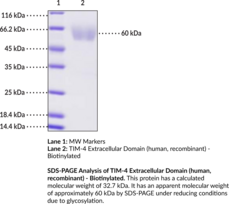
TIM-4 is a type I transmembrane protein and member of the T cell immunoglobulin and mucin domain-containing (TIM) family of immunoregulatory proteins.1 It is composed of an N-terminal immunoglobulin variable (IgV) domain that binds to phosphatidylserine, as well as a mucin stalk, which contains O- and N-linked glycosylation sites, a transmembrane domain, and a C-terminal cytoplasmic tail, which lacks a tyrosine phosphorylation site, unlike TIM-1 and TIM-3.2,1 TIM-4 is expressed in antigen-presenting cells (APCs) such as dendritic cells and macrophages and binds to TIM-1 on activated T cells.3 It is mainly involved in phagocytosis of apoptotic cells via recognition of phosphatidylserine, but also plays a role in T cell proliferation and survival, viral entry, and antitumor immunity.2,4,5,6 TIM-4 targeting antibodies prevent HIV-1 entry into host cells in vitro and enhance the efficacy of anticancer vaccines in a murine melanoma model.5,6 SNPs in TIMD4 are associated with increased susceptibility of asthma in children.7 Cayman's TIM-4 Extracellular Domain (human, recombinant) - Biotinylated protein consists of 302 amino acids, has a calculated molecular weight of 32.7 kDa, and a predicted N-terminus of Glu25 after signal peptide cleavage. By SDS-PAGE, the apparent molecular mass of the protein is approximately 60 kDa due to glycosylation.
WARNING This product is not for human or veterinary use.
References & Product Citations
1. TIM genes: A family of cell surface phosphatidylserine receptors that regulate innate and adaptive immunity. Immunol. Rev. 235(1), 172-189 (2010).
2. Identification of Tim4 as a phosphatidylserine receptor. Nature 450, 435-439 (2007).
3. TIM-
4. TIM-
5. Role of TIM-
6. Combined blockade of TIM-
7. Association of TIM4 promoter polymorphism -
Contact Info
Cayman Chemical1180 East Ellsworth RoadAnn Arbor, Michigan 48108 USAToll Free: (800) 364-9897(USA and Canada only)Fax: (734) 971-3640


