
Technical Support & Resources
Visit our FAQ
Contact Us
Toll Free Phone (USA and Canada Only): (888) 526-5351
Direct Phone: (734) 975-3888
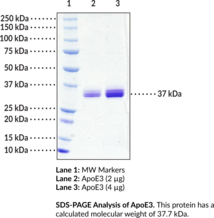
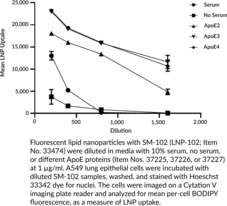
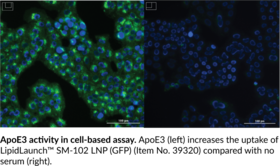
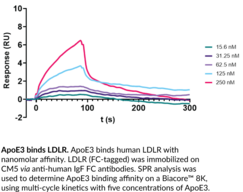
Technical Information
- Apolipoprotein E3
Shipping & Storage Information
Recommended Products
Certificates of Analysis & Batch Specific Data
Provide batch numbers separated by commas to download or request available product inserts, QC sheets, certificates of analysis, data packs, and GC-MS data.
Lipid Resource Center
Discover Products & Resources for Lipid Research
- High-purity lipid standards
- Lipid roles in biology
- Lipids in health & disease
- Lipids for pharmaceutical development
- Protocols, advice, & resources
Product Description
ApoE is a member of the superfamily of amphiphilic exchangeable apolipoproteins and a lipid carrier protein with a major role in lipid homeostasis.1,2 It is expressed in astrocytes, hepatocytes, monocytes, macrophages, and kidney cells and exists as three major polymorphic alleles, ApoE2, ApoE3, and ApoE4, which occur in the United States population with frequencies of approximately 7, 79, and 14%, respectively. ApoE is composed of an N-terminal domain, which contains sequences for binding to members of the LDL receptor family, and a C-terminal domain, containing the major lipid-binding region, linked by an unstructured hinge region, which facilitates domain mobility essential to protein function.1 Upon lipid binding, ApoE undergoes a conformational change that orients the α-helices of the C-terminal domain perpendicular to the acyl chains of the bound lipids to stabilize the bound lipids and facilitates recognition and binding to LDL receptors by the N-terminal domain. ApoE isoforms vary at amino acids 130 and 176 (112 and 158, respectively, in the mature protein) with ApoE2 containing cysteine at 130 and 176, ApoE3 containing cysteine at 130 and arginine at 176, and ApoE4 containing arginine at 130 and 176. ApoE3 forms homodimers via disulfide bond formation. ApoE3 is more efficient than ApoE4, but less efficient than ApoE2, at promoting cholesterol efflux in astrocytes, and APOE3-expressing astrocytes accumulate fewer but larger lipid droplets than astrocytes expressing APOE4.3,4 Unlike the increased risk of Alzheimer’s disease associated with the ApoE4 variant, ApoE3 is neutral with respect to Alzheimer’s disease risk, and ApoE3 with a valine-to-glutamine substitution at position 236 (ApoE3V236E) is associated with a reduced risk for the disease.5 Cayman’s ApoE3 (human, recombinant) protein can be used for cell-based assays.
WARNING This product is not for human or veterinary use.
References & Product Citations
1. .
2. .
3. .
4. .
5. .
Contact Info
Cayman Chemical1180 East Ellsworth RoadAnn Arbor, Michigan 48108 USAToll Free: (800) 364-9897(USA and Canada only)Fax: (734) 971-3640


