
Technical Support & Resources
Information provided in the product description is from published literature. Due to the nature of scientific experimentation, your results (e.g., selectivity and effective concentrations) or specific application for this product may differ. If you have questions about how this product fits your application, please contact our technical support staff.
Visit our FAQ
Contact Us
Toll Free Phone (USA and Canada Only): (888) 526-5351
Direct Phone: (734) 975-3888

Technical Information
Shipping & Storage Information
Recommended Products
Certificates of Analysis & Batch Specific Data
Provide batch numbers separated by commas to download or request available product inserts, QC sheets, certificates of analysis, data packs, and GC-MS data.
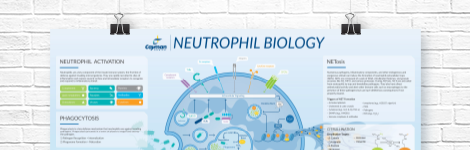
Neutrophil Biology Wall Poster
Explore how neutrophils shape the immune response in health and disease. This poster highlights neutrophil pathogen defense mechanisms, including phagocytosis, degranulation, and NETosis, as well as neutrophil roles in inflammation and NET-associated pathologies.
DOWNLOAD NOWProduct Description
Ezeprogind is an inhibitor of amyloid precursor protein (APP) proteolysis.1 It reduces the proteolysis of full-length APP to Aβ1-38 (IC50 = 5 µM) and Aβ1-40 (IC50 = 2 µM) in SH-SY5Y cells expressing APP. Ezeprogind induces APP intracellular domain (AICD) expression at a doubling (C2) value of 0.8 µM without inducing cytotoxicity in wildtype SH-SY5Y cells at a 50% cytotoxic concentration (CC50) value of 30 µM. It inhibits cell death, dendritic network degradation, and loss of synapse integrity induced by Aβ1-42 in primary rat cortical neurons when used at concentrations of 10, 50, and 100 nM.2 Ezeprogind (10, 50, and 100 nM) decreases Aβ1-42-induced Il-β and Il-6 secretion from, and the activation levels of, microglia in primary rat cortical neurons. It prevents and reverses the decline in spatial alternation retention in the Y-maze special alternation task in the SAMP8 mouse model of rapid aging and dementia when administered at a dose of 3 mg/kg per day in drinking water for eight months and at the same dose for six and four months, respectively. It decreases the number of hippocampal activated microglia in SAMP8 mice treated for eight and six months but not four months. Ezeprogind also reduces the proliferation of chloroquine-resistant P. falciparum (IC50 = 40.6 nM).3
WARNING This product is not for human or veterinary use.
References & Product Citations
1. Chloroquine and chloroquinoline derivatives as models for the design of modulators of amyloid peptide precursor metabolism. ACS Chem. Neurosci. 6(4), 559-569 (2015).
2. AZP2006, a new promising treatment for Alzheimer’s and related diseases. Sci. Rep. 11(1), 16806 (2021).
3. Synthesis and antimalarial evaluation of new 1,4-
Contact Info
Cayman Chemical1180 East Ellsworth RoadAnn Arbor, Michigan 48108 USAToll Free: (800) 364-9897(USA and Canada only)Fax: (734) 971-3640


