
Features
- Screen test samples to quantify functional activity, either activating or inhibitory, that they may exert against human p53
- Robust technology provides sustained response for consistent and reproducible data acquisition
- Included in kit: Ready-to-use, pre-transfected reporter cells | Optimized media | Reference activator | Luciferase detection reagent | Cell culture-ready assay plate
Technical Support & Resources
Visit our FAQ
Contact Us
Toll Free Phone (USA and Canada Only): (888) 526-5351
Direct Phone: (734) 975-3888
Product Categories
Product Type
Application
Technical Information
- Cellular Tumor Antigen P53
- TP53
- Tumor Suppressor P53
- Tumor Protein P53
- Phosphoprotein p53
Shipping & Storage Information
Recommended Products
Certificates of Analysis & Batch Specific Data
Provide batch numbers separated by commas to download or request available product inserts, QC sheets, certificates of analysis, data packs, and GC-MS data.


Visit Our Cancer Resource Center
Find Tools & Resources to Study the Hallmarks of Cancer
- Cancer cell signaling & regulation
- Cancer metabolism
- Tumor microenvironment
Product Description
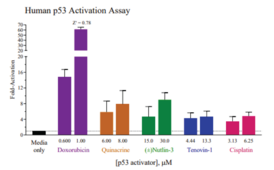
This Human Tumor Protein p53 Reporter Assay System is an all-inclusive luciferase reporter assay system that includes in addition to p53 Reporter Cells, two optimized media for use during cell culture and in diluting test samples, the reference p53 activator Doxorubicin (hydrochloride), Luciferase Detection Reagent, two cell culture-ready assay plates, and a detailed protocol.
Tumor protein P53, also known as p53, acquired its reputation as “guardian of the genome” through its ability to sense and respond to cellular stress, preventing accumulation of DNA damage and subsequent formation of malignancies. p53 is a transcription factor and tumor suppressor that responds to cellular stress by regulating genes involved in a diverse array of cellular responses, including but not limited to, cell cycle arrest, DNA repair, apoptosis, senescence, and autophagy, thus minimizing the negative consequences of genetic mutation. p53 is expressed at low levels in cells in the absence of stress, regulated by various factors including MDM2 (also known as HDM2), which acts as a negative regulator through its E3 ubiquitin ligase activity, and WIP1/PPM1D, which also acts as a negative regulator of p53 through its ability to dephosphorylate specific residues on both p53 and MDM2, leading to the destabilization of p53 and the stabilization of HDM2, respectively. p53 in turn directly influences the expression of these two negative regulators, as both MDM2 and WIP1/PPM1D are target genes of p53.
p53 is the most commonly mutated gene in human cancer formation, and is therefore of interest in cancer research and therapeutic development. Potential therapeutics may target the p53 pathway in several ways. These include restoration of mutated p53 to its wild-type conformation and targeting regulators of p53 activity, for example, by inhibiting MDM2. The small molecule PRIMA-1, as well as derivates of the thiosemicarbazone family, have been shown to restore wild-type p53 activity, and several classes of MDM2 inhibitors, including nutlins, have been developed and studied. Since the causes, results, and regulation of p53 activation are diverse and context-dependent, therapeutics targeting the p53 pathway are necessarily diverse as well.
INDIGO's p53 Reporter Cells include the luciferase reporter gene functionally linked to a p53-responsive promoter. Thus, quantifying changes in luciferase expression in the treated reporter cells provides a sensitive surrogate measure of the changes in human p53 activity. [INDIGO Catalog No. IB25001-48]
WARNING This product is not for human or veterinary use.
Contact Info
Cayman Chemical1180 East Ellsworth RoadAnn Arbor, Michigan 48108 USAToll Free: (800) 364-9897(USA and Canada only)Fax: (734) 971-3640


