
Technical Support & Resources
Visit our FAQ
Contact Us
Toll Free Phone (USA and Canada Only): (888) 526-5351
Direct Phone: (734) 975-3888
Product Categories
Product Type
Technical Information
- Keratan Sulfate Proteoglycan Osteomodulin
- KSPG Osteomodulin
- OMD
- OSAD
- Osteoadherin
Shipping & Storage Information
Certificates of Analysis & Batch Specific Data
Provide batch numbers separated by commas to download or request available product inserts, QC sheets, certificates of analysis, data packs, and GC-MS data.
Product Description
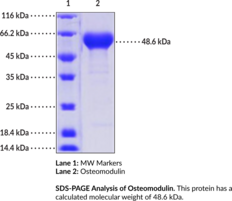
Osteomodulin (OMD), is a class II keratan sulfate small leucine-rich proteoglycan (SLRP) with roles in bone mineralization, cell adhesion, tooth formation, and the regulation of collagen fibrils.1,2 It is primarily expressed in mineralized tissues, including bones and teeth, but is also expressed in articular chondrocytes and fibrochondrocytes.1 OMD binds to bone morphogenetic protein 2 (BMP2), promoting SMAD signaling and osteogenesis. It also binds to type I collagen and induces morphology and size changes in collagen fibrils, indicating a role in the regulation of extracellular matrix components during bone formation.2 Increased plasma levels of OMD are associated with cardiac calcification in patients with chronic kidney disease (CKD).3 Serum levels of OMD are increased and positively correlated with plaque calcification in patients with carotid atherosclerosis. Serum levels of OMD are also decreased in patients with osteoarthritis.4 Cayman’s Osteomodulin (human, recombinant) protein consists of 412 amino acids, has a calculated molecular weight of 48.6 kDa, and a predicted N-terminus of Gln21 after signal peptide cleavage.
WARNING This product is not for human or veterinary use.
References & Product Citations
1. Osteomodulin positively regulates osteogenesis through interaction with BMP2. Cell Death Dis. 12(2), 147 (2021).
2. Osteomodulin regulates diameter and alters shape of collagen fibrils. Biochem. Biophys. Res. Commun. 463(3), 292-296 (2015).
3. Osteomodulin attenuates smooth muscle cell osteogenic transition in vascular calcification. Clin. Transl. Med. 12(2), e682 (2022).
4. Proteomic analysis of osteoblasts secretome provides new insights in mechanisms underlying osteoarthritis subchondral bone sclerosis. Osteoarthritis Cartilage 26(Suppl 1), S89 (2018).
Contact Info
Cayman Chemical1180 East Ellsworth RoadAnn Arbor, Michigan 48108 USAToll Free: (800) 364-9897(USA and Canada only)Fax: (734) 971-3640


