
Technical Support & Resources
Visit our FAQ
Contact Us
Toll Free Phone (USA and Canada Only): (888) 526-5351
Direct Phone: (734) 975-3888
Product Categories
Product Type
Technical Information
- Dipeptidyl Peptidase 10
- Dipeptidyl Peptidase IV-related Protein 3
- Dipeptidyl Peptidase-like Protein 2
- Dipeptidyl Peptidase Y
- DPL2
- DPRP-3
Shipping & Storage Information
Recommended Products
Certificates of Analysis & Batch Specific Data
Provide batch numbers separated by commas to download or request available product inserts, QC sheets, certificates of analysis, data packs, and GC-MS data.
Product Description
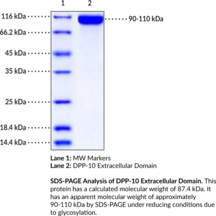
Dipeptidyl peptidase 10 (DPP-10) is a catalytically inactive member of the prolyl oligopeptidase protein family.1,2,3 It is a type II transmembrane glycoprotein that lacks the serine residue of the catalytic triad essential to the serine protease activity observed in other DPPs.1 DPP-10 is expressed at high levels in the brain, pancreas, spinal cord, and adrenal glands, with lower levels in the placenta, liver, and trachea.2 Co-expression of DPP-10 with Kv4.2 voltage-gated potassium channels enhances channel currents and accelerates channel inactivation and recovery in Xenopus oocytes. Bronchoalveolar lavage fluid (BALF) levels of DPP-10 are increased in various mouse models of asthma, and serum levels of DPP-10 are increased in patients with NSAID-exacerbated respiratory disease (NERD).3 Cayman’s DPP-10 Extracellular Domain (human, recombinant) protein consists of 760 amino acids and has a calculated molecular mass of 87.4 kDa. By SDS-PAGE, under reducing conditions, the apparent molecular mass of the protein is approximately 90-110 kDa due to glycosylation.
WARNING This product is not for human or veterinary use.
References & Product Citations
1. Structure of human dipeptidyl peptidase 10 (DPPY): A modulator of neuronal Kv4 channels. Sci. Rep. 5, 8769 (2015).
2. Modulation of Kv4.2 channel expression and gating by dipeptidyl peptidase 10 (DPP10). Biophys. J. 87(4), 2380-2396 (2004).
3. Contribution of dipeptidyl peptidase 10 to airway dysfunction in patients with NSAID-
Contact Info
Cayman Chemical1180 East Ellsworth RoadAnn Arbor, Michigan 48108 USAToll Free: (800) 364-9897(USA and Canada only)Fax: (734) 971-3640


