
Technical Support & Resources
Visit our FAQ
Contact Us
Toll Free Phone (USA and Canada Only): (888) 526-5351
Direct Phone: (734) 975-3888
Product Categories
Product Type
Technical Information
- ADM
- AM
Shipping & Storage Information
Recommended Products
Certificates of Analysis & Batch Specific Data
Provide batch numbers separated by commas to download or request available product inserts, QC sheets, certificates of analysis, data packs, and GC-MS data.
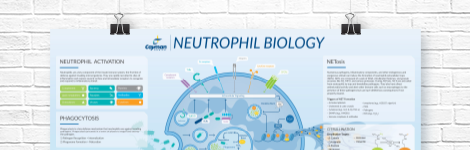
Neutrophil Biology Wall Poster
Explore how neutrophils shape the immune response in health and disease. This poster highlights neutrophil pathogen defense mechanisms, including phagocytosis, degranulation, and NETosis, as well as neutrophil roles in inflammation and NET-associated pathologies.
DOWNLOAD NOWProduct Description
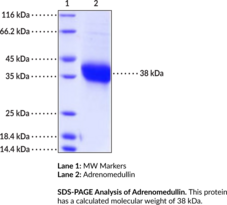
Adrenomedullin is a vasodilatory peptide hormone and member of the calcitonin peptide family encoded by ADM in humans, with roles in vasodilation, angiogenesis, inflammation, organ protection, and tissue repair.1,2,3 ADM codes for a 185-amino acid precursor, preproadrenomedullin (preproAM), which is converted to proadrenomedullin (proAM) after cleavage of a signal peptide.3 proAM is then enzymatically processed to generate both adrenomedullin and proAM N-terminal 20 peptide (PAMP). Adrenomedullin is expressed in the adrenal medulla, heart, lung, and kidney as well as human umbilical vein endothelial cells (HUVECs) and in human glomerular epithelial and hematopoietic cell lines.1 It is also expressed in pheochromocytomas, neuroendocrinal tumors of the adrenal gland. It is protective against mechanical ventilation-induced lung injury and sepsis, as well as liver and gut injury induced by ventilator-induced lung injury in a mouse model of pneumococcal pneumonia infection.4 Adrenomedullin increases survival and reduces chemotherapy-induced cardiotoxicity in mice.5 It also reduces hyperoxia-induced right ventricular hypertrophy and artery thickness in a rat model of bronchopulmonary dysplasia.1 Cayman's Adrenomedullin (human, recombinant) protein is a disulfide-linked homodimer. The reduced monomer, composed of adrenomedullin (amino acids 95-146) fused to human IgG1 Fc at its N-terminus, consists of 340 amino acids and has a calculated molecular weight of 38 kDa.
WARNING This product is not for human or veterinary use.
References & Product Citations
1. Regulation of endothelial and epithelial barrier functions by peptide hormones of the adrenomedullin family. Tissue Barriers 4(4), e1228439 (2016).
2. Adrenomedullin dilates the pulmonary vascular bed in vivo. J. Appl. Physiol. 76(5), 2154-2156 (1994).
3. Adrenomedullin: Not just another gastrointestinal peptide. Biomolecules 12(2), 156 (2022).
4. Mechanical ventilation drives pneumococcal pneumonia into lung injury and sepsis in mice: Protection by adrenomedullin. Crit. Care 18(2), R73 (2014).
5. Effects of adrenomedullin on doxorubicin-
Contact Info
Cayman Chemical1180 East Ellsworth RoadAnn Arbor, Michigan 48108 USAToll Free: (800) 364-9897(USA and Canada only)Fax: (734) 971-3640


