
Technical Support & Resources
Visit our FAQ
Contact Us
Toll Free Phone (USA and Canada Only): (888) 526-5351
Direct Phone: (734) 975-3888
Technical Information
- CD209 Antigen Isoform 1
- CLEC4L
- C-type Lectin Domain Family 4 Member L
- DC-SIGN1A Type I
- Dendritic Cell-specific ICAM-3-grabbing Non-integrin 1
Shipping & Storage Information
Recommended Products
Certificates of Analysis & Batch Specific Data
Provide batch numbers separated by commas to download or request available product inserts, QC sheets, certificates of analysis, data packs, and GC-MS data.
Neutrophil Biology Wall Poster
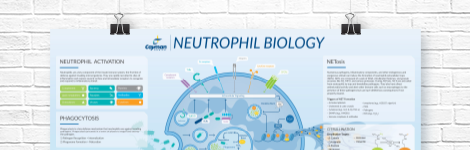
Explore how neutrophils shape the immune response in health and disease. This poster highlights neutrophil pathogen defense mechanisms, including phagocytosis, degranulation, and NETosis, as well as neutrophil roles in inflammation and NET-associated pathologies.
DOWNLOAD NOWProduct Description
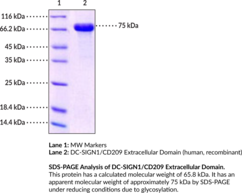
Dendritic cell-specific ICAM-3-grabbing non-integrin 1 (DC-SIGN1), also known as CD209, is a type II transmembrane glycoprotein and member of the C-type lectin receptor superfamily.1,2 It is composed of an N-terminal cytoplasmic domain, a transmembrane domain, a neck region that contains seven repeats of 23 amino acids and is involved in oligomerization, and a carbohydrate recognition domain. However, DC-SIGN1 undergoes extensive alternative splicing that results in at least 12 membrane-bound or soluble isoforms.1,3 It is expressed in dendritic cells and macrophages, dermal, mucosal, intestine, and lung tissues, as well as blood and lymph nodes.1,2 DC-SIGN1 is involved in cell-cell adhesion and migration via interactions with intracellular cell adhesion molecule-2 (ICAM-2) and ICAM-3, recognition of viral and bacterial pathogens, and the immune response.1,2,4 It binds to HIV-1 gp120 and the receptor-binding domain of spike glycoprotein, also known as surface glycoprotein, of severe acute respiratory syndrome coronavirus 2 (SARS-CoV-2).5,6 Dendritic cell expression of human CD209 increases survival in a mouse model of M. tuberculosis infection.4 SNPs in CD209 are associated with increased disease severity in patients with dengue viral infection.7 Cayman’s DC-SIGN1/CD209 Extracellular Domain (human, recombinant) protein is a disulfide-linked homodimer. The reduced monomer, composed of DC-SIGN1 (amino acids 62-404) fused to human IgG1 Fc at its N-terminus, consists of 580 amino acids and has a calculated molecular weight of 65.8 kDa. As a result of glycosylation, the monomer migrates at approximately 75 kDa by SDS-PAGE under reducing conditions.
WARNING This product is not for human or veterinary use.
References & Product Citations
1. C-
2. DC-
3. Extensive repertoire of membrane-
4. Decreased pathology and prolonged survival of human DC-
5. DC-
6. CD209L/L-
7. Importance of NFκβ, IL-
Contact Info
Cayman Chemical1180 East Ellsworth RoadAnn Arbor, Michigan 48108 USAToll Free: (800) 364-9897(USA and Canada only)Fax: (734) 971-3640


