
Technical Support & Resources
Visit our FAQ
Contact Us
Toll Free Phone (USA and Canada Only): (888) 526-5351
Direct Phone: (734) 975-3888
P-Selectin Glycoprotein Ligand-1/CD162 Extracellular Domain (human, recombinant; His- and Fc-tagged)
Item No. 38062
Technical Information
- CD162
- Cluster Of Differentiation 162
- PSGL-1
- Selectin P Ligand
- SELPLG
Shipping & Storage Information
Recommended Products
Certificates of Analysis & Batch Specific Data
Provide batch numbers separated by commas to download or request available product inserts, QC sheets, certificates of analysis, data packs, and GC-MS data.
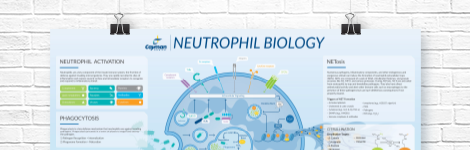
Neutrophil Biology Wall Poster
Explore how neutrophils shape the immune response in health and disease. This poster highlights neutrophil pathogen defense mechanisms, including phagocytosis, degranulation, and NETosis, as well as neutrophil roles in inflammation and NET-associated pathologies.
DOWNLOAD NOWProduct Description
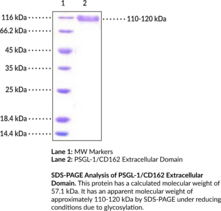
P-selectin glycoprotein ligand 1 (PSGL-1), also known as CD162, is a cell surface glycoprotein encoded by SELPLG in humans that binds to P-, E-, and L-selectins to mediate the rolling and tethering of immune cells on endothelium for migration into sites of inflammation.1,2,3 It is expressed as a homodimer on myeloid and lymphoid cells, including platelets, and is composed of an extracellular domain, which contains branching sites for glycosylation and sulfation, a transmembrane domain, and a cytoplasmic domain.2 PSGL-1 selectin binding requires post-translational modifications, including sulfation and glycosylation, and these modifications are constitutively present on PSGL-1 in innate immune cells and differentiated T cells.4 Ectopic expression of PSGL-1 in CD4+ T cells inhibits processing and incorporation of the HIV-1 envelope glycoprotein, disrupting attachment of viral progeny to target cells but does not inhibit HIV-1 infection.5 It also inhibits the incorporation of severe acute respiratory syndrome coronavirus (SARS-CoV) and SARS-CoV-2 spike glycoproteins into pseudovirions and blocks pseudovirus attachment and infection of target cells.3 Cayman’s PSGL-1 (human, recombinant; His- and Fc-tagged) protein is a disulfide-linked homodimer. The reduced monomer, composed of PSGL-1 (amino acids 18-295) fused to His-tagged human IgG1 Fc at its C-terminus, consists of 526 amino acids, has a calculated molecular weight of 57.1 kDa, and a predicted N-terminus of Leu18 after signal peptide cleavage. As a result of glycosylation, the monomer migrates at approximately 110-120 kDa by SDS-PAGE under reducing conditions.
WARNING This product is not for human or veterinary use.
References & Product Citations
1. PSGL-
2. PSGL-
3. PSGL-
4. PSGL-
5. PSGL-
Contact Info
Cayman Chemical1180 East Ellsworth RoadAnn Arbor, Michigan 48108 USAToll Free: (800) 364-9897(USA and Canada only)Fax: (734) 971-3640


