
Technical Support & Resources
Visit our FAQ
Contact Us
Toll Free Phone (USA and Canada Only): (888) 526-5351
Direct Phone: (734) 975-3888
Technical Information
- Palmitoyl-protein Hydrolase 1
- Palmitoyl-protein Thioesterase 1
- CLN1
Shipping & Storage Information
Recommended Products
Certificates of Analysis & Batch Specific Data
Provide batch numbers separated by commas to download or request available product inserts, QC sheets, certificates of analysis, data packs, and GC-MS data.
Lipid Resource Center
Discover Products & Resources for Lipid Research
- High-purity lipid standards
- Lipid roles in biology
- Lipids in health & disease
- Lipids for pharmaceutical development
- Protocols, advice, & resources
Product Description
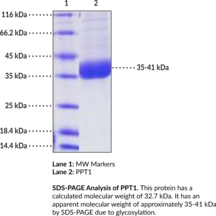
Palmitoyl-protein thioesterase 1 (PPT1) is a lysosomal hydrolase involved in removing palmitic acid (Item No. 10006627) from post-translationally modified proteins prior to their degradation.1 It is mainly expressed in the brain but is also found in visceral macrophages from liver, lung, and bowel tissues.2 PPT1 depalmitoylates proteins in cells undergoing autophagy, and PPT1 activity is important for axon outgrowth, neurite extension, and dendritic spine morphology.1 Knockout of PPT1 decreases tumor growth in a mouse xenograft model, and high expression of PPT1 is associated with poor overall survival in several cancers.3 Mutations in PPT1 cause infantile neuronal ceroid lipofuscinoses (INCL), an encephalopathy characterized by granular deposits in neurons, vision loss, seizures, mental deterioration, and brain death.4,5 Cayman’s PPT1 (human, recombinant) protein consists of 290 amino acids, has a calculated molecular weight of 32.7 kDa, and a predicted N-terminus of Asp28 after signal peptide cleavage. By SDS-PAGE, under reducing conditions, the apparent molecular mass is 35-41 kDa due to glycosylation.
WARNING This product is not for human or veterinary use.
References & Product Citations
1. Depalmitoylation by palmitoyl-
2. Tissue expression and subcellular localization of CLN3, the Batten disease protein. Mol. Genet. Metab. 66(4), 283-289 (1999).
3. PPT1 promotes tumor growth and is the molecular target of chloroquine derivatives in cancer. Cancer Discov. 9(2), 220-229 (2019).
4. Mutations in the palmitoyl protein thioesterase gene causing infantile neuronal ceroid lipofuscinosis. Nature 376(6541), 584-587 (1995).
5. Lipid thioesters derived from acylated proteins accumulate in infantile neuronal ceroid lipofuscinosis: Correction of the defect in lymphoblasts by recombinant palmitoyl-
Contact Info
Cayman Chemical1180 East Ellsworth RoadAnn Arbor, Michigan 48108 USAToll Free: (800) 364-9897(USA and Canada only)Fax: (734) 971-3640


